Agentic Data Pipelines: How AI Agents Build, Monitor, and Fix Them
- October 18, 2026
TL;DR
- Pipeline failures cost large enterprises an average of $3 million a month in business exposure, and each incident takes nearly 13 hours to resolve, according to Fivetran’s 2026 benchmark of 500 senior data and technology leaders. Agents are being pointed at exactly this problem.
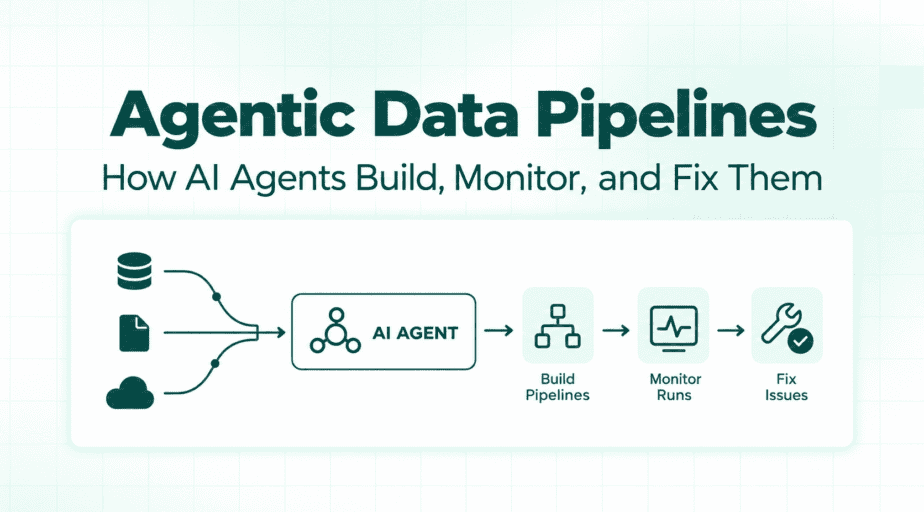
- An agentic data pipeline is one where an AI agent handles part of the build, monitor, and fix cycle by running a loop of observing, deciding, calling a tool, and checking the result. It is different from a scheduled DAG and different from a chat assistant that autocompletes SQL.
- Agents can write pipeline code faster than teams can review it, and DORA’s 2025 research found that higher AI adoption is associated with both higher delivery throughput and higher delivery instability. The gap is context: an agent sees the file in front of it, not the downstream dashboards, runtime costs, or other teams’ branches.
- The fix is to give the agent three kinds of context before it acts: column-level lineage, operational lineage (what actually ran, and what it cost), and versioned history. Gartner expects over 40% of agentic AI projects to be canceled by the end of 2027 over cost, unclear value, or weak risk controls, and missing context is a large part of why.
- Datameer supplies that context today through impact reports on GitHub pull requests and an investigation agent that works across catalog, lineage, history, and observability logs. It reads and reports. It does not change your pipelines for you.
Most data teams used to write every transformation by hand and review every change line by line. That workflow had a natural speed limit: the rate at which a person could type, think, and read someone else’s diff. Coding agents removed the limit on the typing side. A data engineer can now describe a change in a sentence and get back a working SQL rewrite, a new Airflow DAG, or a refactored dbt model in under a minute. The review side did not speed up at all, and the estate those changes land in keeps getting bigger and more tangled.
This guide covers the three jobs people are now handing to agents: building pipelines, monitoring them, and fixing them when they break. You will learn what makes a pipeline agentic in the first place, why agent-written changes break things that look unrelated, what metadata an agent needs to avoid that, and how the plumbing works, with real code. The piece then walks through a safe rollout. It stays on the agent loop itself. For the metadata layer underneath, see our guide to active metadata management, which this piece builds on rather than repeats.
What Are Agentic Data Pipelines in Plain Terms?
A data pipeline moves data from where it is produced to where people use it, with transformations in between. In a typical stack that means a source system, an ingestion tool, a warehouse such as Snowflake, a transformation layer such as dbt, an orchestrator such as Airflow or Dagster that decides what runs when, and some consumers: dashboards, reverse-ETL syncs, notebooks, or a model that scores transactions.
In a conventional setup, every decision in that chain was made ahead of time by a human. The orchestrator runs steps in a fixed order because someone wrote the DAG that way. An agentic pipeline adds an agent to the chain. An agent is a language model running in a loop: it observes some state, decides what to do, calls a tool (run a query, read a file, post a comment), looks at the result, and decides again. The pipeline is agentic to the degree that this loop is making real decisions about the pipeline rather than just filling in text.
The distinction is easier to see side by side.
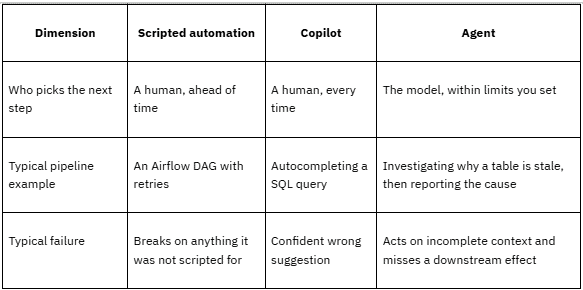
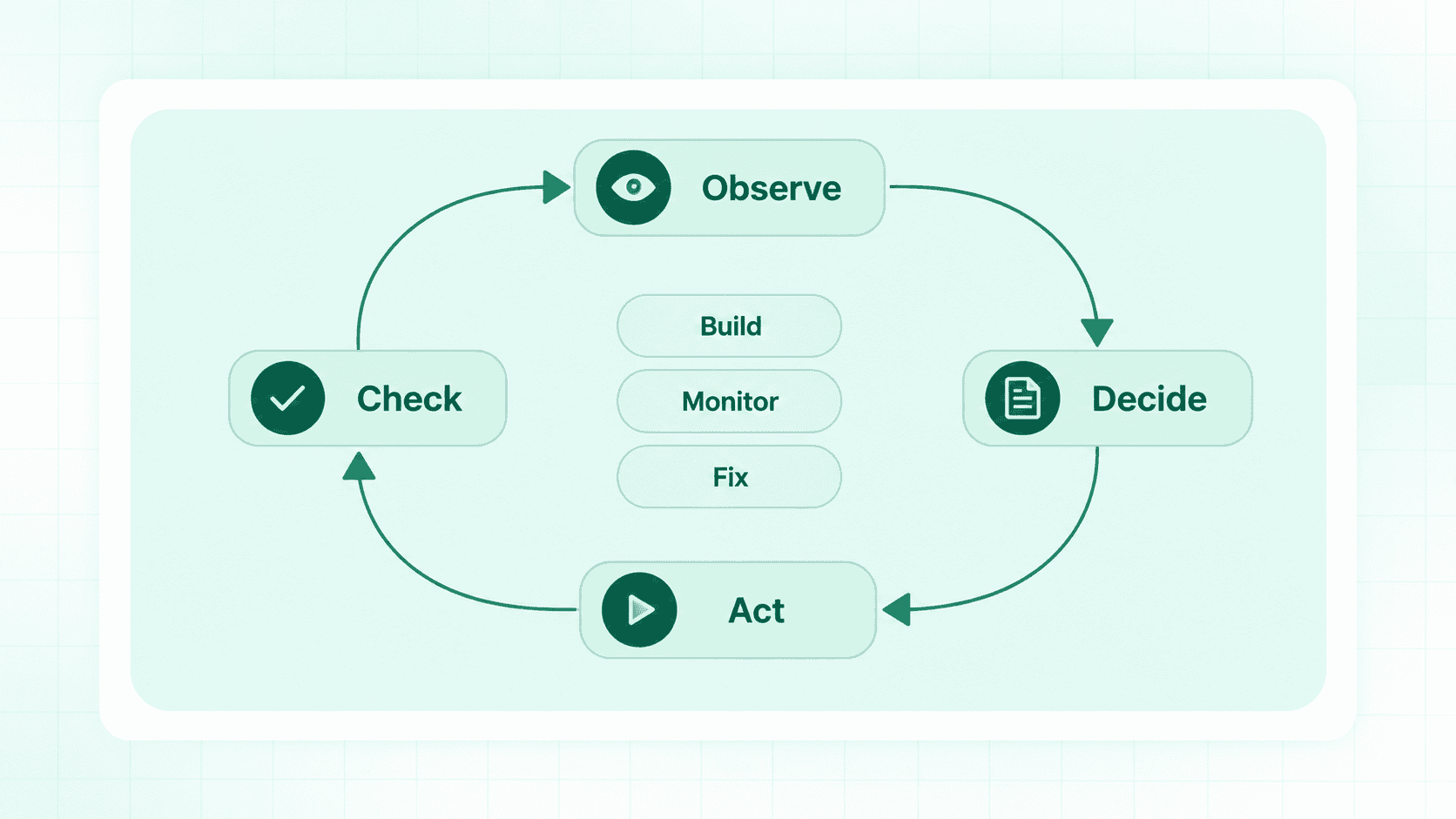
Be a little skeptical of the label. Gartner has noted that many vendors are rebranding chatbots and RPA as agentic AI without substantial agentic capabilities. A useful test is to ask what decision the system makes that a script could not have made. If the answer is none, it is automation with a new name, which is fine, but it will not behave like the agents discussed below.
How AI Agents Build Pipelines Today
Building is where adoption is furthest along. According to the 2025 Stack Overflow Developer Survey, 84% of respondents are using or planning to use AI tools in their development process. The same survey shows that agents specifically are still niche, with 14.1% of respondents using them daily, and that more developers distrust the accuracy of AI output (46%) than trust it (33%). Both numbers tell the same story. The tooling is spreading quickly, and the people using it do not fully trust it.
For pipeline work, the common jobs look like this:
- Writing and rewriting SQL. Optimizing a slow join, pivoting a table, adding a derived column.
- Scaffolding orchestration. Generating an Airflow or Dagster job for a new source, with schedules and dependencies.
- Refactoring transformation code. Splitting a 600-line model into staged layers, or renaming a column across a project.
- Migrating between platforms. Translating stored procedures or legacy ETL into warehouse-native SQL.
All four are tasks where an agent does well on the code it can see. To keep the rest of this guide concrete, we will follow one scenario. It is hypothetical, but every step in it is a pattern data teams will recognize.
A payments company runs Snowflake, dbt, and Airflow. A fraud-scoring service reads a feature table called fraud_features, which is built from orders_enriched, which joins orders to customer risk data. An engineer asks a coding agent to make orders_enriched cheaper to run. The agent rewrites the join, the dbt tests pass, the output columns are unchanged, and a reviewer approves a clean-looking diff. Nothing in that sequence was careless. The problem shows up the next morning, and it takes the rest of this guide to explain why nobody could have seen it from the diff.
Why Agent-Written Pipeline Code Is Locally Smart and Globally Blind
The agent in our scenario made a correct change to the problem in front of it. What it could not know is spread across systems it had no view into. The catalog lists tables but says little about who uses them. The orchestrator knows what runs when, but not what the SQL does. The warehouse’s query history knows what a job cost, but only for jobs that already ran. And the most relevant context of all, what other engineers are about to ship, lives in unmerged branches that no tool combines.
That fragmentation is why DORA’s finding about instability has a mechanism behind it. When throughput rises, the number of changes grows faster than any reviewer’s ability to hold the whole estate in their head. A change can look individually fine and still cause trouble three systems away.
Back in our scenario, here is what happened to the “clean” rewrite. The new join returned the same rows, so tests passed. But it forced Snowflake to scan far more data, and in this illustrative case the job scanned about four times the bytes and finished 19 minutes later than before. fraud_features then refreshed after the fraud model’s scoring window, the model started working with stale inputs, and false positives climbed through the afternoon. Nobody on the data team knew the fraud service existed on the other side of that table.
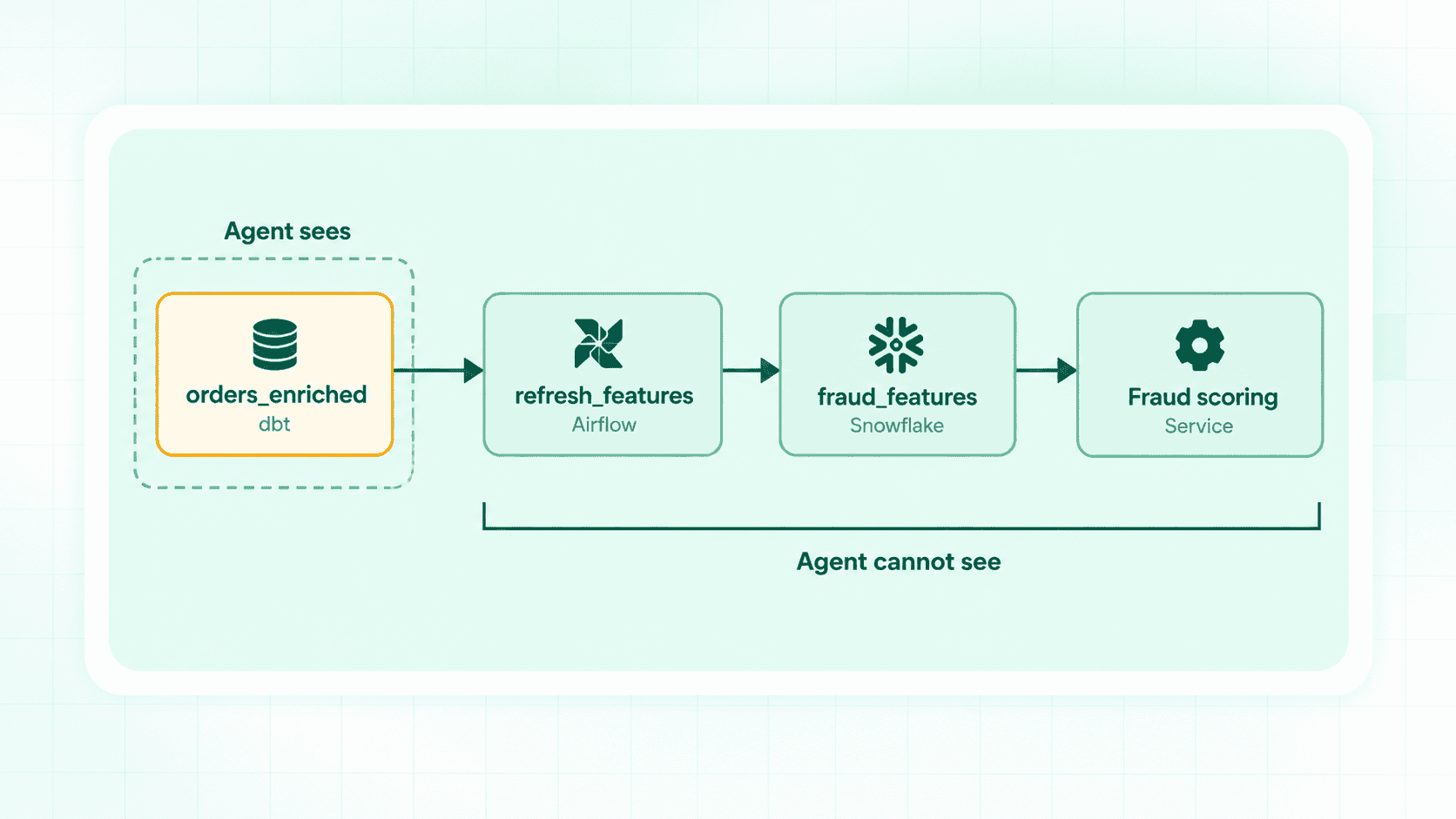
The fix for blindness is not a smarter model. The agent was smart enough. It needed to be told what the warehouse, orchestrator, and consumers already knew.
What Context an Agent Needs Before It Changes Anything
An agent that is about to touch a pipeline needs answers to three questions. Each one maps to a different kind of metadata, and each one lives in a different system today.
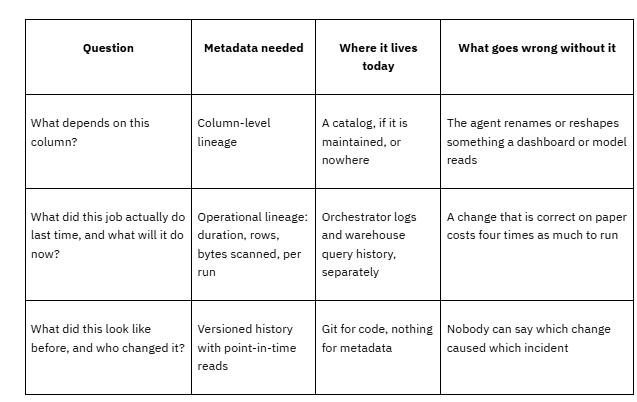
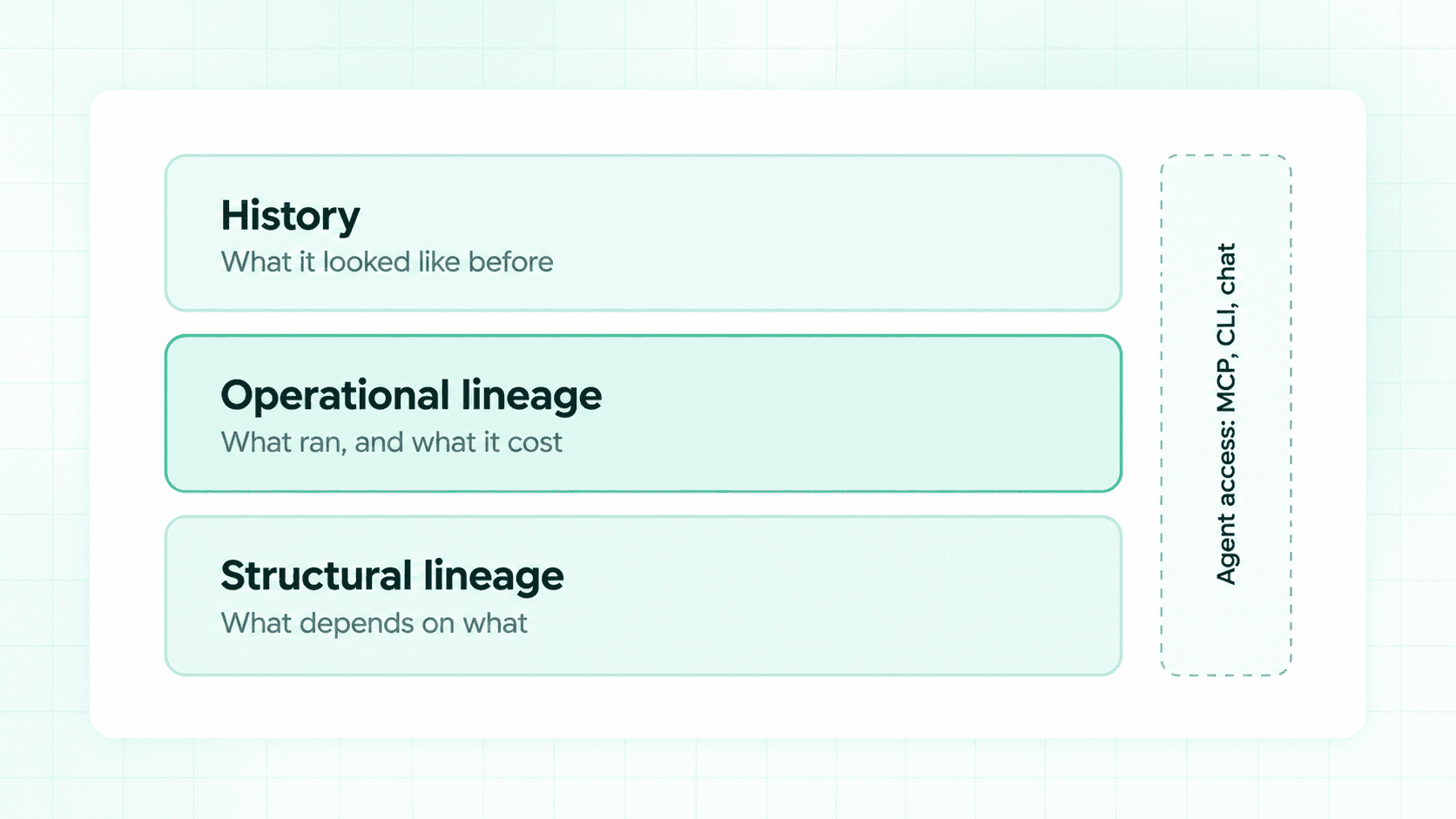
Structural lineage tells you which models break. Operational lineage tells you what the new version costs. Teams that only have the first can see the shape of the graph but not the weight on its edges, which is how the scenario above got through review.
An agent also needs a way to ask for this context. The Model Context Protocol (MCP) is an open-source standard for connecting AI applications to external data sources, tools, and workflows, and it has become the common way to do that. It is worth treating as plumbing. Nearly every vendor in this space will offer an MCP server, so the question to ask is not whether an agent can reach your metadata, but whether the metadata it reaches is complete, current, and joined across systems.
How Pipelines Emit the Events Agents Depend On
Where does this metadata come from? In most modern stacks it comes from OpenLineage, an open standard that models three things. A Job is a process that consumes or produces datasets. A Run is one occurrence of a job in time, identified by a unique run ID. A Dataset is an abstract representation of data, such as a table. Orchestrators and compute engines emit events as runs start and finish, and extra detail travels as facets attached to those entities.
One of those facets does a lot of work for agents: the SQL facet, which carries the query a job executed. That is different from reading the code in a repository, because it records what ran rather than what someone intended to run. The OpenLineage Python client documentation shows the pattern:
from datetime import datetime, timezone

from openlineage.client import OpenLineageClient

from openlineage.client.event_v2 import Dataset, Job, Run, RunEvent, RunState

from openlineage.client.facet_v2 import sql_job

from openlineage.client.uuid import generate_new_uuid

client = OpenLineageClient(config={

    "transport": {

        "type": "http",

        "url": "http://localhost:5000",  # replace with your lineage endpoint

    }

})

run = Run(runId=str(generate_new_uuid()))

producer = "https://example.com/pipelines/orders-enriched"

client.emit(

    RunEvent(

        eventType=RunState.COMPLETE,

        eventTime=datetime.now(timezone.utc).isoformat(),

        run=run,

        job=Job(

            namespace="payments_warehouse",

            name="orders_enriched",

            facets={

                "sql": sql_job.SQLJobFacet(

                    query="SELECT o.order_id, o.amount, c.risk_tier "

                          "FROM orders o JOIN customers c ON o.customer_id = c.id"

                )

            },

        ),

        producer=producer,

        inputs=[

            Dataset(namespace="payments_warehouse", name="analytics.orders"),

            Dataset(namespace="payments_warehouse", name="analytics.customers"),

        ],

        outputs=[

            Dataset(namespace="payments_warehouse", name="analytics.orders_enriched"),

        ],

    )

)
A real integration also emits a START event at the beginning of the run, and you rarely write this by hand. Orchestrators do it for you. If you run Airflow, the OpenLineage provider is configured with a transport setting in airflow.cfg, as described in the Airflow provider’s user guide:
[openlineage]

transport = {"type": "http", "url": "http://localhost:5000", "endpoint": "api/v1/lineage"}
The same setting can be supplied as the environment variable AIRFLOW__OPENLINEAGE__TRANSPORT. Once that is in place, job runs, dataset relationships, and executed code begin flowing to whatever endpoint you point at. This is an event-driven model: metadata arrives as things happen, rather than waiting for a nightly crawl. It is also why the context stays current enough for an agent to trust.
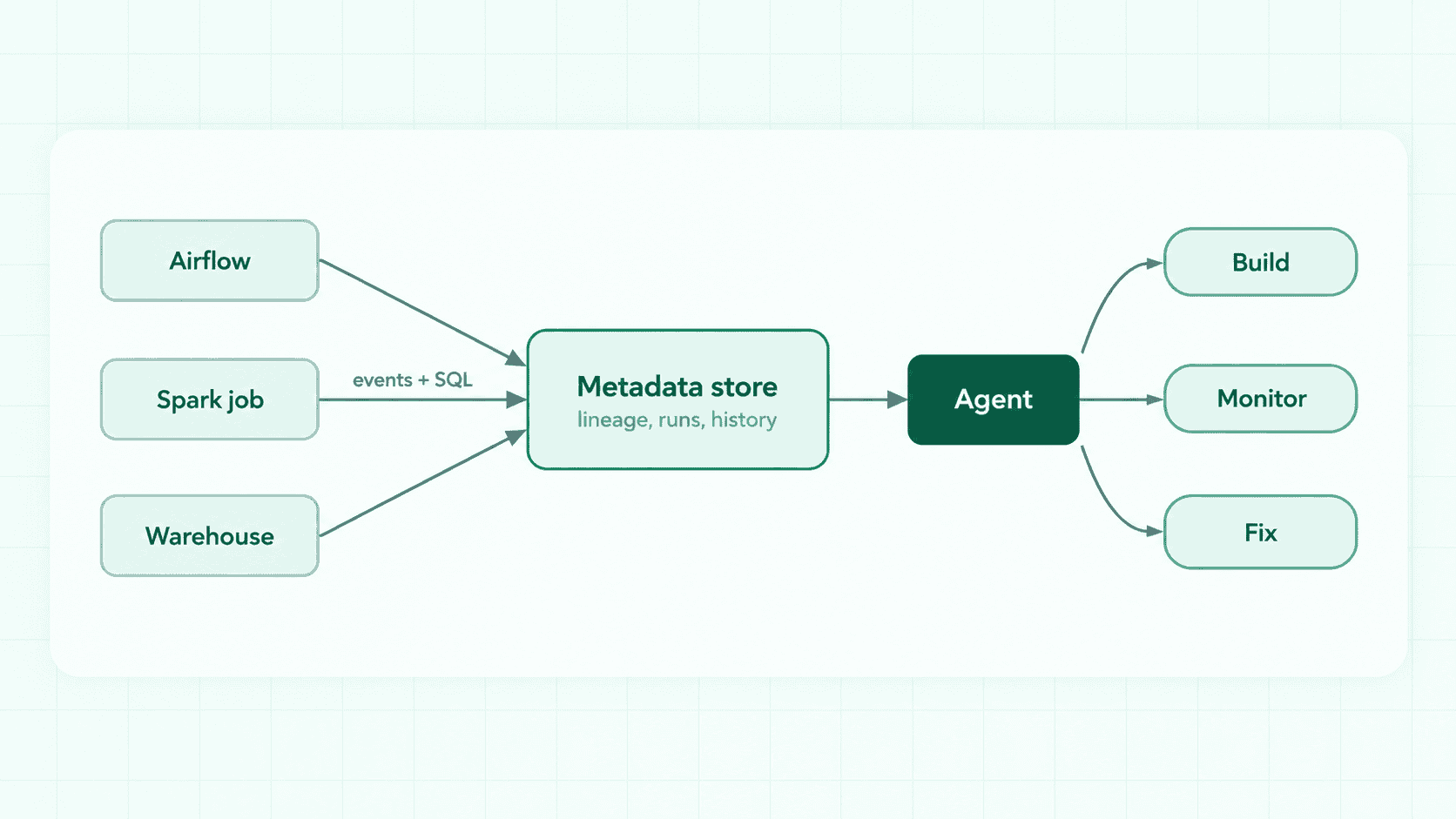
With events flowing, the agent has something to work from. The next question is what it does with it.
How Agents Monitor Pipelines Between Failures
Monitoring is the job most teams hand to agents second, and it is where the cost numbers live. In the Fivetran data cited at the top, organizations see an average of 4.7 pipeline breaks a month. Fivetran’s report write-up adds that 53% of engineering time goes to pipeline maintenance. A good share of that time goes to noticing and diagnosing, not to the repair itself.
An agent that monitors does three things better than a dashboard of red and green tiles.
It compares versions, not just thresholds. A static alert fires when a job runs longer than some fixed number of minutes. An agent with run history can compare the same job across two versions and notice that duration, bytes scanned, or records read changed sharply right after a merge. In our scenario, that comparison would have flagged the rewrite before the fraud model ever saw stale data.
It reacts to events. Because runs and schema changes arrive as events, the agent can respond when a change lands instead of when someone remembers to look. A new dataset appears, a column type changes, a job’s SQL differs from last week’s, and each of those is something the agent can inspect on arrival.
It tells you what it cannot see. A useful agent reports the edges of its own map. If a job writes to a system that is not emitting events, the right output is a note saying that namespace is unmapped, not silence that reads as all clear. Silent gaps are how monitoring earns false confidence.
There is a boundary worth stating plainly. Monitoring in this sense covers the metadata and runtime layer: what ran, how it behaved, and what depends on it. It does not compare the contents of the data row by row, and it is a different job from a data quality monitor that checks values against expectations. Teams usually want both, but they are different tools.
How Agents Investigate and Fix Broken Pipelines
Investigation is where agents earn their keep fastest, because the work is mostly gathering context from several places and connecting it, which is something language models do well when the context is reachable.
Return to the fraud scenario. False positives are rising. A data platform lead asks the agent why. A well-equipped agent works through it in order:
- Start at the symptom. It looks up fraud_flags and walks upstream through column-level lineage to fraud_features and then orders_enriched.
- Check what changed. It reads the versioned history for that job and finds that the SQL changed at a specific time, in a specific pull request, by a specific author.
- Compare behavior across versions. It pulls run metrics for the old and new versions and sees duration up, bytes scanned up, and a completion time that now lands after the scoring window.
- Read the logs. It reaches the observability tool, such as Datadog, for the job’s runtime logs in the same context, so it does not have to hand off between systems.
- Report. It answers the original question: what happened, who changed it, when, and what it affected.
That sequence used to take an engineer a few hours of switching between a catalog, an orchestrator UI, a warehouse console, and a logging tool. Fivetran’s figure of nearly 13 hours per incident suggests the average case is worse.
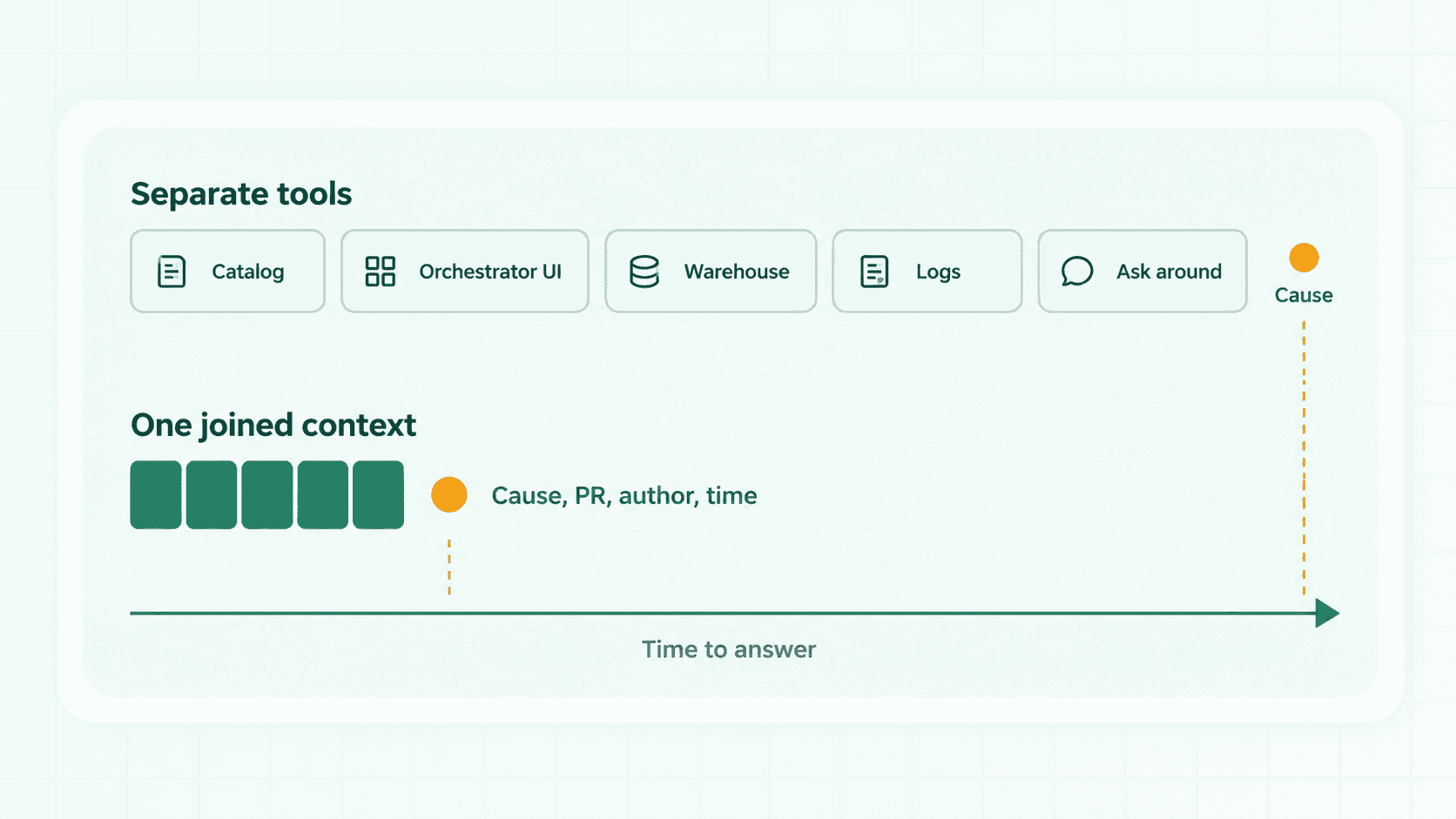
Fixing is the part to be careful about. An agent that diagnoses a problem and proposes a patch is useful. An agent that rewrites production pipelines on its own is a different bet, and the evidence that it works reliably is thin. Look at how the failures happen: an agent acting on incomplete context makes a locally reasonable change that causes a downstream problem, and an autonomous fixer repeats exactly that failure mode with nobody watching. The practical approach today is for the agent to investigate, recommend, and draft, and for a human to approve what ships. That keeps the speed of the investigation and keeps a person accountable for the change.
How Datameer Gives Agents the Missing Pipeline Context
Everything above rests on one requirement: before an agent changes or diagnoses anything, it needs lineage, runtime behavior, and history, joined across the platforms in the estate. Datameer’s new active metadata product is built around that requirement. A note on fit first: if you are shopping for a data catalog, a business glossary, or a data quality monitor, this is a different category, and it is better to know that now.
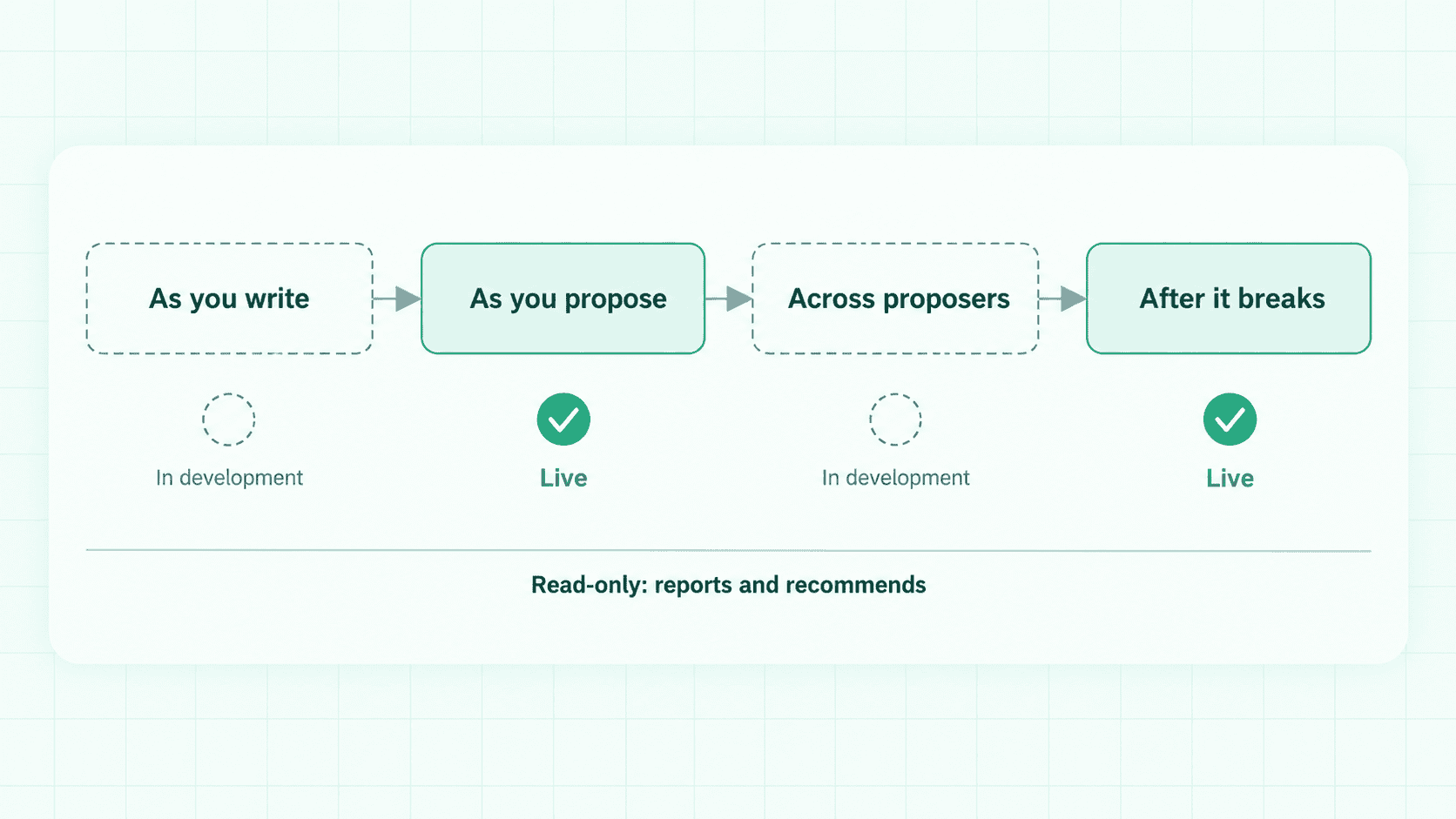
Impact analysis on pull requests. Datameer connects to GitHub. When a pull request opens, a webhook triggers an agent workflow that produces an impact report on the PR itself. The report covers which downstream assets are affected, and it includes a runtime comparison between the old and new versions of the job: duration, result rows, result bytes, bytes scanned, and records read. This closes the gap in our scenario. A tool that only reports which models break would have shown an unchanged schema and a green check. A runtime comparison shows the new version scanning far more data before anyone merges it. The pull request flow is GitHub-specific today.
Investigation in one context. For the “why did this break” question, the agent has the catalog, column-level lineage, versioned history with point-in-time reads, and access to operational telemetry from tools like Datadog, all in a single turn. That is the five-step investigation described earlier, without the handoffs.
Column-level lineage without manual curation. Lineage is derived by parsing the SQL each job actually executed, which arrives through the code facets described above. Where an edge is inferred rather than confirmed, Datameer marks it as inferred, so you can see what the system is confident about and what it is guessing.
Cross-platform reach and honest coverage. The catalog spans systems that emit OpenLineage events, Snowflake, and other non-dbt sources, which is what an estate of mixed tools needs. Systems that are not yet covered are flagged as unmapped rather than ignored.
Where you ask. You can talk to it in the pull request thread, in Slack, in a web chat, or from a CLI.
Where Agentic Pipelines Still Fall Short Today
Gartner’s prediction that over 40% of agentic AI projects will be canceled by 2027 names three causes: escalating costs, unclear business value, and inadequate risk controls. Each one has a data-pipeline version.
Cost. An agent that explores a warehouse by running exploratory queries spends real compute. A narrow, well-scoped agent with access to precomputed metadata is cheaper than one that rediscovers the estate from scratch on every question.
Unclear value. “We have an agent” is not a metric. Measure what it replaces: hours per incident, pull requests that shipped with an unreviewed downstream effect, or time from alert to cause.
Risk controls. This is the one data teams should take most seriously. Give agents the narrowest credentials that work, prefer read access to write access, and keep a human approval step in front of anything that changes production. The incident described above came from a code change, and a faster author of code changes needs a stronger gate, not a weaker one.
There is also a technical limit that no amount of tooling removes. Agents are only as good as the metadata they can see. If half your jobs do not emit events, the agent’s map has holes, and it will reason confidently around them unless the system tells it where the holes are.
How to Roll Out Agentic Pipelines Safely
Teams that get value from agents tend to expand in stages, with each stage earning the next.
- Instrument first. Before any agent exists, get your orchestrators and compute engines emitting events. The Airflow configuration shown earlier is a one-line change to start. Coverage is the foundation, and unmapped systems should be visible, not assumed.
- Start read-only, with investigation. The first agent should only answer questions: why did this fail, what depends on this table, what changed on Tuesday. Investigation is low risk, high value, and quick to judge for accuracy.
- Put the agent on the pull request. Add impact reports to review. Reviewers get the downstream list and the runtime comparison without hunting for them. Humans still approve.
- Let agents draft changes, gated by impact. Once agent-written pull requests are going through the same impact report as human ones, you can allow more of them without more review hours.
- Review the gaps monthly. Look at what the agent flagged as unmapped, which incidents it misdiagnosed, and where reviewers overrode it. That list is your roadmap for the next quarter.
Where Should You Start With Agentic Pipelines
Agents can build, monitor, and fix pipelines, and they are already doing the first two for many teams. The reason their changes still cause incidents is not that they write bad code. It is that they write good code against partial information, in an estate where lineage, runtime cost, and history sit in different tools. The teams that benefit most are the ones that fix the information problem first: events flowing, lineage derived from the SQL that actually ran, and runtime behavior compared across versions before a change merges. Fixing is the part to keep human-approved for now.
To start, turn on OpenLineage events in your orchestrator and ask an agent one real question about your own estate, such as what breaks if a specific column changes. If you want that context joined across platforms, with impact reports on your GitHub pull requests, see how Datameer works. For the layer beneath all of this, read our guide to active metadata management.
FAQs
What is an agentic data pipeline? It is a pipeline where an AI agent handles part of building, monitoring, or fixing the pipeline by running a loop of observing, deciding, calling tools, and checking results. A scheduled DAG with retries is automation. It becomes agentic when something makes decisions a script could not have made in advance.
Do agents replace orchestrators like Airflow or Dagster? No. The orchestrator still runs the jobs on schedule and in order. Agents work around it: writing the job code, watching run events, and investigating failures. In practice the orchestrator is also where the metadata that agents rely on is emitted.
Can an agent fix a broken pipeline on its own? It can diagnose and draft a fix reliably when it has the right context. Letting it change production without review is riskier, because the typical failure is a locally correct change with a downstream effect nobody checked. Most teams keep a human approving anything that ships.
What metadata does an agent need to avoid breaking downstream consumers? Three kinds: column-level lineage to know what depends on what, operational lineage to know what a job costs and how long it runs, and versioned history to know what changed and when. Having only the first tells you which models break but not what the new version costs.
Which Git providers does Datameer’s pull request impact analysis support? GitHub. The pull request flow is GitHub-specific today, and the product is read-only outside the comments it posts.