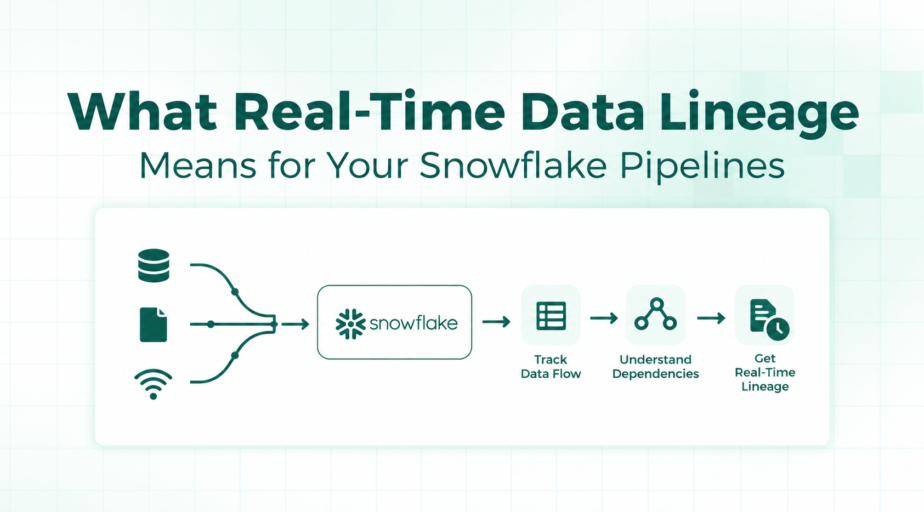
What Real-Time Data Lineage Means for Your Snowflake Pipelines
- October 18, 2026
TL;DR
- Enterprises running fragmented pipeline stacks lose an average of $3 million a month to pipeline failures, and each incident takes close to 13 hours to resolve, according to Fivetran’s 2026 Enterprise Data Infrastructure Benchmark.
- The EU AI Act now carries fines of up to €35 million or 7% of global turnover for the highest violation tier, and DORA already applies to roughly 22,000 EU financial entities; both require firms to show where a number came from on demand.
- Most lineage records are built from a scheduled crawl, so there is a gap between when a change ships and when the lineage graph catches up, sometimes hours wide.
- Structural lineage shows that a column still resolves correctly. It does not show that the same query now scans four times the data or blows past a runtime SLA, which is the part that actually breaks budgets and dashboards.
- Datameer’s approach to operational lineage runs impact analysis directly on the pull request, comparing runtime metrics between job versions rather than just checking whether the SQL still parses.
Most data teams past a certain size are not working with a single warehouse anymore. There is Snowflake at the center, an orchestrator scheduling the transformation layer, a BI tool a few hops downstream, and usually something legacy that nobody wants to touch but everybody still depends on. Each of those systems can change independently, and the person making a change in one rarely has visibility into what it touches three systems away. That gap between how fast pipelines change and how well anyone can see across them is where most production incidents actually start.
This piece covers what real-time lineage means in practice, why regulatory pressure in 2026 has made it harder to treat as optional, and how it differs from the lineage most Snowflake teams already have through native platform features. It also walks through the four common ways teams try to capture lineage today, what a purely structural lineage record misses that a runtime-aware one catches, and what to check for when evaluating an approach for your own environment.
How Data Lineage Maps What Depends on What
Data lineage records where a piece of data came from and everywhere it went. At the table level, that means knowing which upstream tables feed a given table. At the column level, it means knowing which specific source column populated a specific target column, through however many transformation steps sit between them. A complete lineage record lets someone start at a dashboard number, a churn score, or a report line item, and trace it backward to the raw source it was built from, or start at a source table and see every downstream consumer that would break if it changed.
Why Most Lineage Records Are Built From a Nightly Snapshot
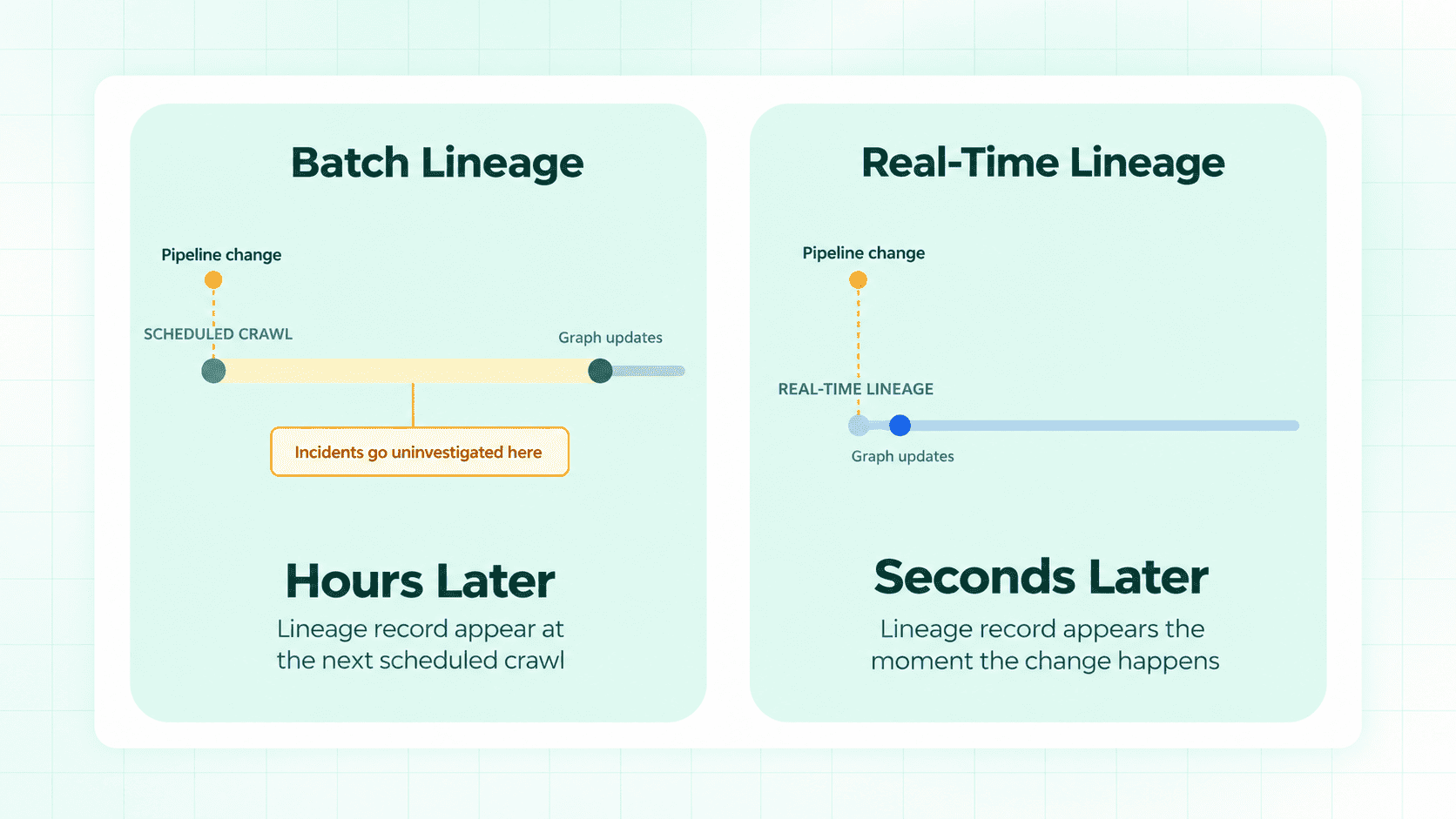
The common way teams get this today is a crawl. A tool scans the warehouse’s query history, catalog metadata, or transformation code on a schedule, usually nightly, and rebuilds the lineage graph from what it finds. That works reasonably well for answering “what does this look like as of yesterday,” but it means the lineage graph is always describing a version of the pipeline that already changed. A column renamed at 9 a.m. will not show up in the lineage graph until the next scheduled crawl runs, and if someone merges a breaking change at 10 a.m. and a downstream job fails at noon, the lineage tool is still showing the old shape of the pipeline while the team investigates.
What Changes When Lineage Updates as Pipelines Run
Real-time lineage closes that gap by updating the record as changes happen, rather than waiting for the next scheduled scan. The practical difference shows up the moment something breaks: instead of pulling up a lineage graph that reflects yesterday’s pipeline, an engineer is looking at a graph that reflects the pipeline as it is running right now, including whatever changed in the last few minutes.
The Gap Between When a Change Ships and When the Record Catches Up
Even Snowflake’s own native lineage, built on the ACCESS_HISTORY and OBJECT_DEPENDENCIES views inside ACCOUNT_USAGE, is not instant, both can lag behind actual query activity by up to three hours, which is a reasonable gap for a governance audit trail and an awkward one during a live incident. The two views also aren’t equally accessible: OBJECT_DEPENDENCIES is available on every Snowflake edition and just needs the OBJECT_VIEWER role, but ACCESS_HISTORY, the view that actually shows which specific queries touched which objects, is gated behind Enterprise Edition and the GOVERNANCE_VIEWER role. A team on Standard plans gets the dependency graph but not the query-level access trail behind it, as Snowflake’s own documentation lays out.
Why Continuous Tracking Is the Real Difference From a Faster Crawl
Real-time does not mean instantaneous in some absolute sense. It means the lineage record is continuously updated as pipelines execute, rather than periodically rebuilt from a scan. A change that ships in a pull request should be reflected in the lineage graph as part of that same workflow, not surfaced hours later when the next crawl happens to run. That distinction matters most exactly when it counts, in the window between a change shipping and someone finding out what it broke.
Why Real-Time Lineage Became Urgent for Regulated Snowflake Teams in 2026
Two regulatory shifts have pushed lineage from a nice-to-have into something auditors expect to see on demand. The EU AI Act’s highest penalty tier now reaches €35 million or 7% of global annual turnover for prohibited AI practices, with lower but still substantial tiers for high-risk system failures and for supplying incorrect information to regulators. Proving where a model’s training or output data came from is a lineage question before it is anything else.
DORA, the EU’s Digital Operational Resilience Act, has applied directly to roughly 22,000 financial entities across the EU since January 2025, requiring firms to demonstrate ICT risk management and incident reporting on a defined timeline. When an incident report must name exactly which downstream systems and reports were affected by a data issue, a team working from a lineage graph that is hours stale reconstructs the picture by hand under a deadline, rather than pulling up a record that already reflects what happened.
Neither regulation was written with data lineage as its subject, but both effectively require it as a byproduct: you cannot demonstrate where a number came from, or which systems an incident touched, without a record that stays current with what the pipeline actually did.
Four Common Ways Teams Try to Capture Lineage Today
Most approaches to capturing lineage fall into one of four categories, and each comes with a different coverage and staleness trade-off.
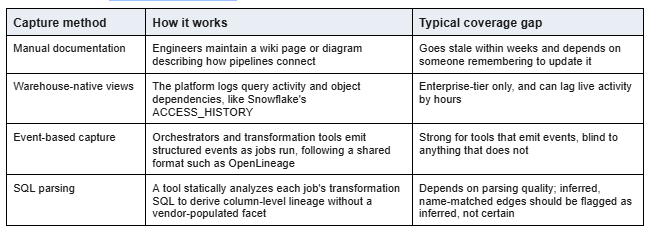
None of these is wrong on its own. The gap most teams run into is treating whichever one they have as complete, when in practice each method sees a different slice of the estate and none of them, on its own, tells you what a change actually cost to run.
What Runtime Behavior Adds That Structural Lineage Alone Misses
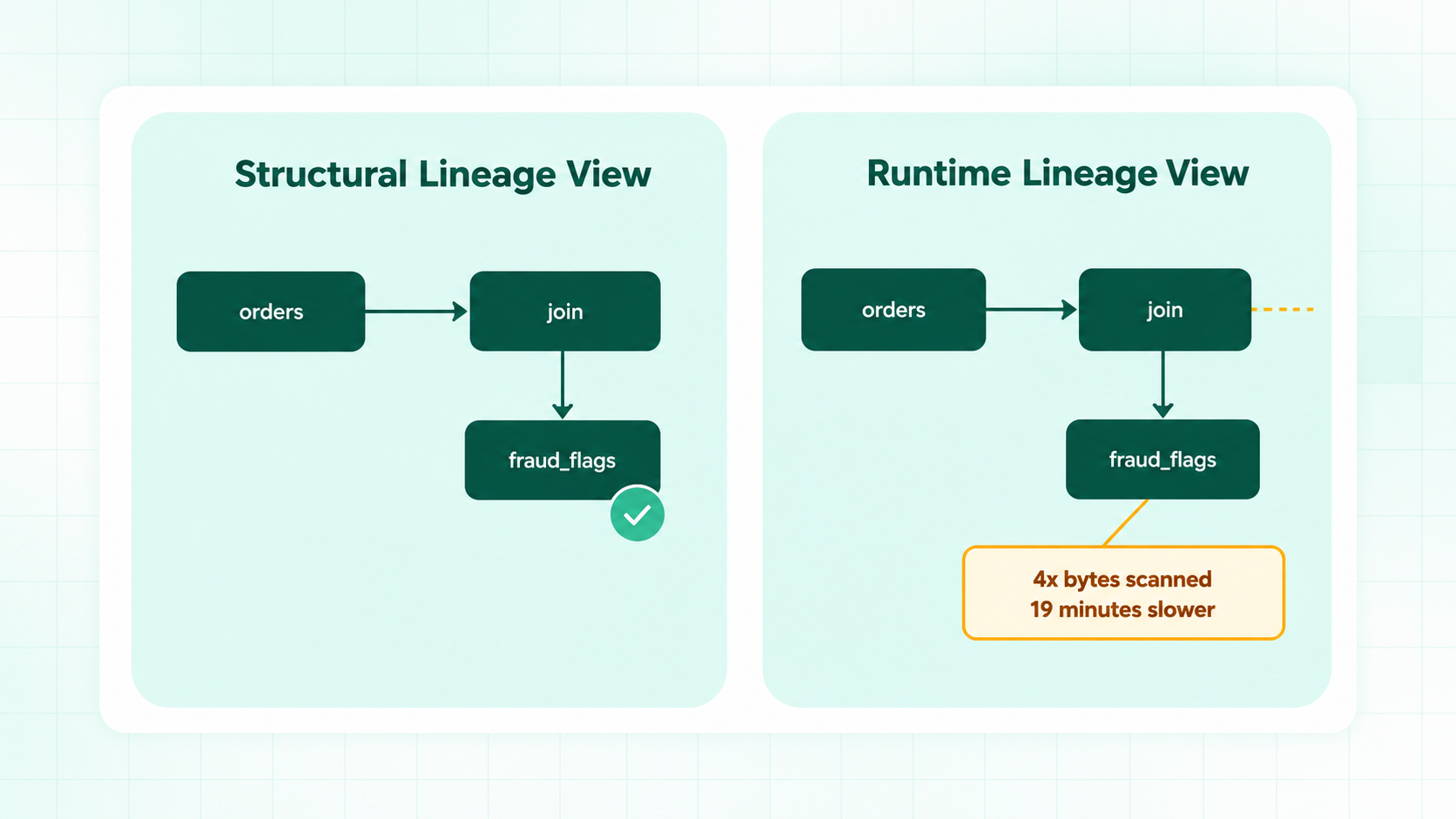
Say a data team at a mid-size SaaS company maintains a nightly job that rolls up subscription events into a monthly recurring revenue table, which feeds both an executive dashboard and a churn prediction model. An engineer adds a join to bring in a new discount field. The SQL is valid, the column resolves correctly, and every lineage tool in the stack, structural ones included, shows the pipeline as healthy. Nothing about the shape of the graph changed.
What structural lineage will not show is that the new join scans a much larger table than before, and the job that used to run in six minutes now runs in twenty-five and scans several times the data it used to. Nobody notices until the warehouse bill jumps or the dashboard starts refreshing late, and by the time someone investigates, the root cause is buried in a change that looked completely fine by every structural measure available.
This is the part of pipeline reliability that costs the most and gets caught the least. Enterprises running fragmented pipeline stacks report an average of $3 million a month in exposure from pipeline failures, with each incident taking close to 13 hours to resolve, and a large share of that time goes to figuring out what actually changed rather than fixing it once the cause is known. Separately, 68% of organizations need four or more hours just to detect that a data quality problem exists in the first place, before investigation even starts. A lineage record that only tracks structure, not runtime behavior, cannot close that detection gap, because the thing that broke was never a structural change to begin with.
Why Lineage Also Has to Catch Collisions Between Teams Working on the Same Tables
A second blind spot shows up as pipelines get more hands on them. Most impact analysis, structural or runtime, compares one proposed change against whatever is currently shipped. That answers “is my change safe against what exists today,” but it does not answer “is someone else changing the same table right now, in a way my change has not accounted for.” Two teams can each ship a change that looks completely safe in isolation and still collide, because the thing that would have caught it, a second team’s in-flight change, was not part of either review.
This gets sharper as AI coding tools take on more of the actual pipeline-writing work. An agent can write a locally correct change for the exact problem in front of it and still have no way to know that another team has an unmerged branch touching the same upstream table this week. That is a coordination problem, not a correctness problem, and it grows faster than the number of changes does as more teams and more automated agents touch the same shared tables. Most lineage tooling in the market today is not built to catch it yet, which makes it one of the more useful questions to ask a vendor directly rather than assume is covered.
How Datameer Approaches Operational Lineage on Snowflake Pipelines
This is the gap Datameer’s approach to lineage is built around closing, specifically the part between a change looking structurally fine and a change actually being fine to ship. Column-level lineage is derived by parsing each job’s transformation SQL, rather than relying on a vendor-populated lineage facet that most tools in the ecosystem don’t consistently provide. Where an edge is inferred through name-matching rather than confirmed through an explicit reference, it is surfaced as inferred, not asserted with the same confidence as a directly traced dependency, so a team can tell the difference between what the system knows and what it is guessing.
The part that maps directly onto the join-that-got-slower scenario above is impact analysis that runs on the pull request itself. When a change is proposed, the workflow compares runtime metrics, job duration, result rows, result bytes, and bytes scanned between the current version of a job and the proposed one, and surfaces that comparison as part of the review, before the change merges. That is a structurally different check than confirming the SQL still parses or the column still exists. It is the difference between “this change is valid” and “this change is going to scan four times the data the old version did,” which is exactly the detail that stayed invisible in the scenario above until the warehouse bill made it visible after the fact.
The same lineage record also flags systems it isn’t yet mapping, rather than silently treating unmapped territory as though it doesn’t exist. For a team migrating off legacy tooling or consolidating platforms, knowing what is not covered yet is close to as useful as knowing what is.
Two Datameer product areas connect directly to this. Job Management already runs impact analysis on scheduled jobs to surface downstream dependencies as they run, and Data Transformation is where the underlying SQL that lineage gets derived from is actually authored and executed on Snowflake’s native compute.
What to Check For When Evaluating a Real-Time Lineage Approach
A few questions are worth asking of any lineage tool before treating it as a source of truth, regardless of vendor.
- How stale can the record get, and under what conditions? Ask for a number, not a description. “Near real-time” can mean anywhere from seconds to several hours depending on the underlying capture method.
- Does it separate confirmed lineage from inferred lineage? A tool that presents a name-matched guess with the same visual confidence as a directly traced dependency will eventually send someone down the wrong path during an incident.
- Does it show runtime impact, not just structural validity? A change that parses correctly and a change that is safe to ship in production are not the same claim, and a tool that only checks the former will miss the failures that actually cost money.
- What happens to a system it does not cover? A lineage record that quietly stops at the edge of its own coverage, with no indication that anything exists beyond it, is more dangerous than one that flags the gap plainly.
- Does it fit into the review workflow your team already uses? A lineage check that lives in a separate dashboard nobody opens gets ignored. One that surfaces inside a pull request, where the change is already being reviewed, gets read.
Where Should You Start
The core shift is that lineage stopped being just a map of how data moves and started needing to also be a record of what each change costs to run. A structurally correct change can still blow a runtime budget, and a tool that only tracks the shape of the pipeline will show that change as healthy right up until the bill or the dashboard says otherwise. Regulatory pressure in 2026 has made the cost of not having that record concrete, and the pipelines running through Snowflake specifically are where most of that exposure sits for teams already native to the platform.
If you are evaluating how your own Snowflake pipelines hold up against this, start by pulling up your team’s lineage source today and checking how stale it actually gets during a busy week, then compare that against how Job Management handles impact analysis on scheduled jobs. From there, the companion piece on this topic covers the regulatory detail in more depth if that is the angle most relevant to your team.
Frequently Asked Questions
Is real-time data lineage the same as data observability?
No. Lineage shows how data moved and what depends on what. Observability monitors whether the data is healthy right now by checking freshness, schema drift, and anomalies. The two answer different questions and work best paired together during an incident.
Do we need real-time lineage if we are not in a regulated industry?
Yes, if more than one team or system depends on the same tables, which covers most teams past a handful of pipelines. Faster root cause analysis and safer change review apply regardless of regulation, and a stale lineage record costs investigation time either way.
How is real-time lineage different from OpenLineage specifically?
OpenLineage is a specific open standard, an event format that orchestrators and transformation tools emit as jobs run, plus a reference backend for collecting those events. Real-time lineage is the broader goal of a record that stays current with execution. OpenLineage is one way to reach that goal for tools that emit the events; a platform-native or SQL-parsing approach reaches the same goal through a different mechanism.
Does Datameer’s approach cover lineage inside Snowflake specifically?
Yes. Lineage is derived from the SQL that runs directly on Snowflake’s native compute inside Datameer’s transformation layer, so the record updates as transformations execute rather than on a separate crawl schedule.
Do we still need a separate lineage tool if we already use Datameer for transformations?
Not for the pipelines built inside Datameer, since transformation and lineage capture happen in the same layer. A separate tool still makes sense for lineage covering systems outside that layer, which is why unmapped-system detection matters as much as coverage of what is already mapped.