Active Metadata Management: What It Is and Why Static Catalogs Can’t Keep Up
- October 18, 2026
TL;DR
- Gartner projects that organizations adopting active metadata practices can cut the time to deliver new data assets to users by up to 70%, because less time goes to manually documenting and reconciling changes that already happened.
- Active metadata management continuously collects, models, and acts on metadata in real time through event-driven ingestion, rather than relying on manual documentation or periodic scans.
- Static catalogs fall out of sync within weeks because nothing in a typical deployment process updates them when a schema, pipeline, or job changes.
- A metadata graph built from observed job runs, rather than parsed code, supports both forward impact analysis and backward root-cause tracing in ways a flat catalog can’t.
- Datameer applies this model directly, building a continuously updated graph of datasets, jobs, and job runs, paired with operational lineage, with development-time context for AI coding agents on its roadmap.
Every data-driven company runs on systems that describe other systems. A schema describes a table, a dashboard describes a query, a pipeline describes how data moves from one place to another. This layer of description, metadata, has quietly become as important as the data itself, because it’s what tells a team, a tool, or an AI agent what any of the underlying data means and how it connects to everything else.
This piece breaks down what active metadata management involves, why static data catalogs consistently fail to keep up with a growing data estate, and how a continuously updated metadata graph changes day-to-day work like impact analysis, root-cause tracing, and governance. It also covers why active metadata is becoming a requirement for AI agents that write and modify pipeline code directly, and how Datameer applies this approach in practice.
What Is Active Metadata Management?
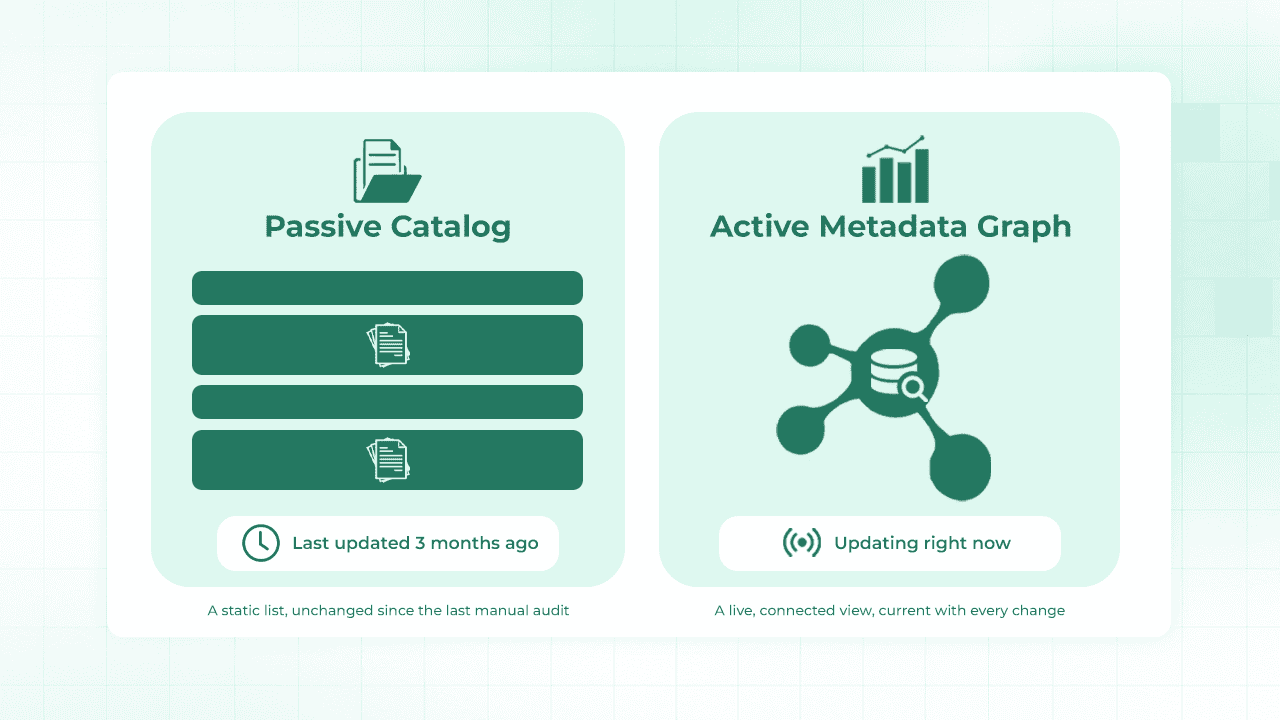
Active metadata management means continuously collecting, updating, and acting on metadata, instead of treating it as a static reference updated occasionally. Metadata is data about data: a table’s schema, a pipeline’s owner, a job’s last run time, the columns a report depends on. A data catalog is the tool that stores and displays that metadata. Active metadata management describes how current that metadata stays.
A catalog can exist without being active. Quarterly audits and manual documentation still produce a catalog, just a passive one. It shows a data estate as it looked at the last update, not as it looks right now.
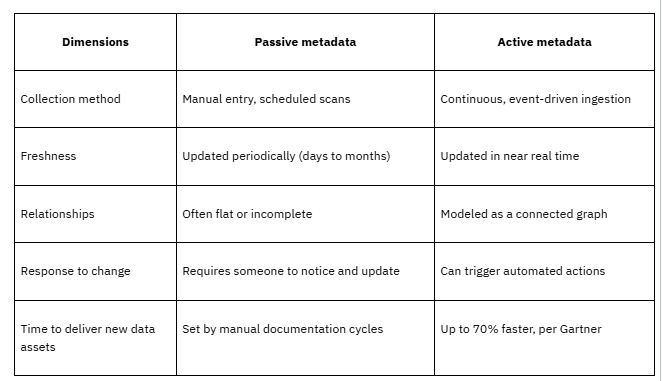
That accuracy gap isn’t abstract. It shows up the first time someone relies on a catalog to make a change, which is exactly where static catalogs start to break down.
Why Do Static Data Catalogs Fall Behind So Quickly?
Static catalogs fall behind because they rely on people remembering to update them, and in a growing data estate, things change constantly. A few examples:
- A new table gets added to the warehouse.
- A column gets renamed in a transformation job.
- A calculation changes quietly, such as a revenue column that now excludes refunded orders.
- A pipeline gets rerouted through a different orchestration step.
- A dashboard starts pulling from a new source.
The rename at least fails loudly. A calculation change is harder to catch. Suppose the same engineer, in the same refactor, changes how revenue is computed in analytics.customer_orders so that refunded orders are excluded. The query still runs, the pipeline stays green, and no test written for the old logic fails. But the finance dashboard now shows a lower number than last quarter’s board deck, and readers have no reason to suspect anything. Nothing broke, so nothing alerted. The cost shows up later, as a business decision made on a number that quietly changed meaning.
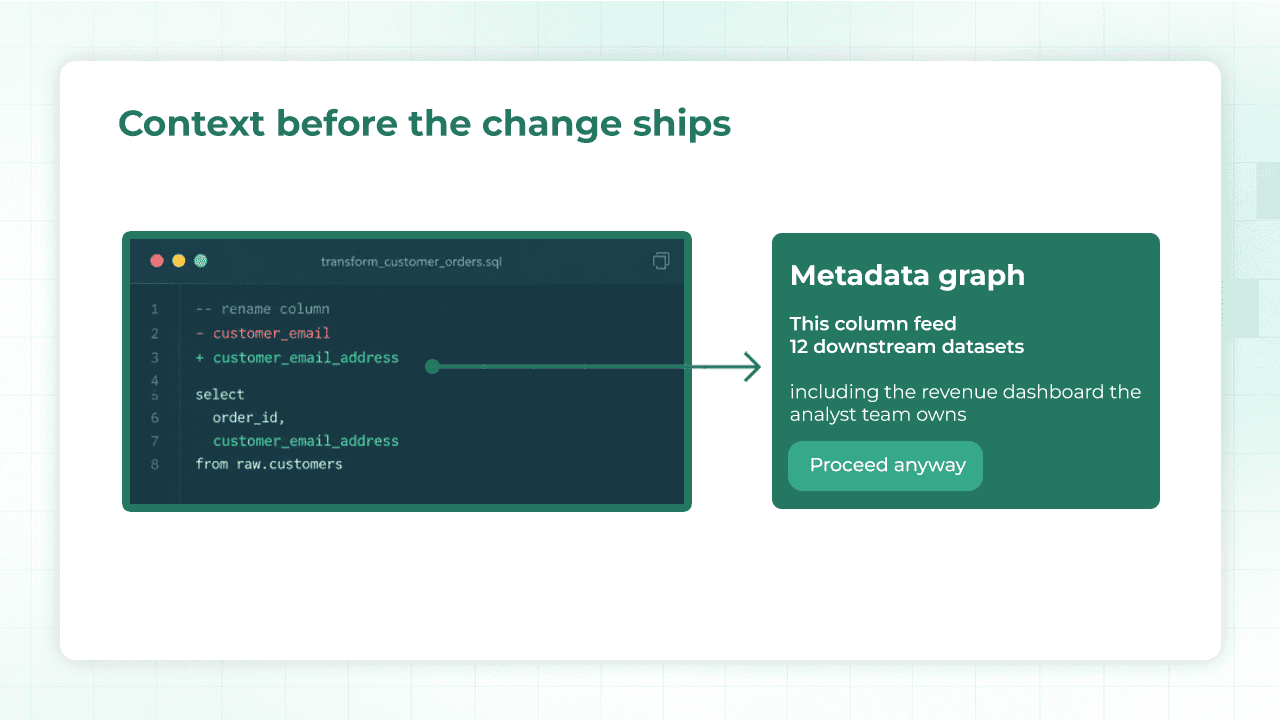
None of these changes show up automatically in a catalog built on manual documentation or periodic scans. Consider a concrete version of this: a data engineer renames the customer_email column in analytics.customer_orders during a routine refactor, tests locally, and ships the change. Nothing in the deployment process touches the catalog, because the catalog isn’t wired into the deployment process at all. Three weeks later, an analyst on a different team builds a revenue dashboard against what the catalog says that column is still called, and the query fails, or worse, silently returns nothing meaningful. Nobody did anything wrong here. The catalog simply can’t know.
This isn’t a discipline problem that better process can solve. Even well-run teams can’t manually document every schema change and pipeline modification across hundreds of tables and dozens of teams. Trust erodes faster than most teams expect, too. Once users catch a catalog error even occasionally, they stop checking it before making changes, which defeats the purpose of maintaining it.
The numbers reflect this gap directly: Gartner research shows organizations that adopt active metadata practices can reduce the time to deliver new data assets to users by up to 70%. That kind of gap is the difference between a catalog people rely on and one they route around. Closing that gap requires a different collection model entirely, not a better-maintained version of the same one.
How Does an Event-Driven Metadata System Work?
Three mechanisms separate an active metadata system from a passive one: continuous event collection, graph-based relationship modeling, and automated action. Each addresses a specific failure mode of static catalogs.
Now run the quieter version of that scenario, where the change is to how revenue is calculated. The graph cannot judge whether the new formula is right, but it knows which datasets and dashboards read that column, and the pull request impact report lists them next to the change. The reviewer sees the same twelve downstream datasets and three dashboards, including the finance revenue dashboard, and can ask the right question before the merge: does the owner of those reports know the definition is changing?
Continuous event collection captures metadata as events happen, not on a schedule. This is commonly built on OpenLineage, an open standard that defines three core entities: a Job (the process that runs), a Run (a single execution of that job), and a Dataset (what the job reads or writes). When a job runs, it emits a sequence of events, typically START, then RUNNING or COMPLETE, and each event can carry facets, structured metadata fragments describing things like row counts, schema, or column-level transformations within that run. This is what it looks like for a job to actually emit that COMPLETE event, using OpenLineage’s own Python client:
from datetime import datetime, timezone

import uuid

from openlineage.client import OpenLineageClient

from openlineage.client.event_v2 import RunEvent, RunState, Job, Run, InputDataset, OutputDataset

client = OpenLineageClient(url="https://lineage.internal.example.com")

event = RunEvent(

    eventType=RunState.COMPLETE,

    eventTime=datetime.now(timezone.utc).isoformat(),

    run=Run(runId=str(uuid.uuid4())),

    job=Job(namespace="warehouse.prod", name="dbt.transform_customer_orders"),

    inputs=[

        InputDataset(namespace="warehouse.prod", name="raw.orders"),

        InputDataset(namespace="warehouse.prod", name="raw.customers"),

    ],

    outputs=[

        OutputDataset(namespace="warehouse.prod", name="analytics.customer_orders"),

    ],

    producer="https://github.com/OpenLineage/OpenLineage/tree/1.22.0/integration/dbt",

)


client.emit(event)

# emit() is fire-and-forget, it doesn't return a response. What it actually

# sends to the metadata system is a serialized event like this:

#

# {

#   "eventType": "COMPLETE",

#   "eventTime": "2026-09-15T02:14:00Z",

#   "producer": "https://github.com/OpenLineage/OpenLineage/tree/1.22.0/integration/dbt",

#   "job": {"namespace": "warehouse.prod", "name": "dbt.transform_customer_orders"},

#   "run": {"runId": "a1b2c3d4-1234-5678-9abc-def012345678"},

#   "inputs": [

#     {"namespace": "warehouse.prod", "name": "raw.orders"},

#     {"namespace": "warehouse.prod", "name": "raw.customers"}

#   ],

#   "outputs": [

#     {"namespace": "warehouse.prod", "name": "analytics.customer_orders"}

#   ]

# }
A tool like Airflow or dbt emits events like this automatically as jobs execute, so the metadata system receives a live feed instead of pulling data on a timer. Critically, this record reflects a job that actually ran with these specific inputs and outputs, not a job definition that might behave this way.
That distinction, between what a pipeline is written to do and what it actually did, is the difference between two ways of building lineage in the first place. Static parsing reads SQL, dbt models, or pipeline definitions and infers dependencies from the code itself, without executing anything. This works cleanly for a simple query joining two named tables. It breaks down when dynamic SQL built from strings at runtime, stored procedures with conditional branches, or parameters resolved only at execution time enter the picture, since a parser that only reads code can’t see what the code becomes at runtime.
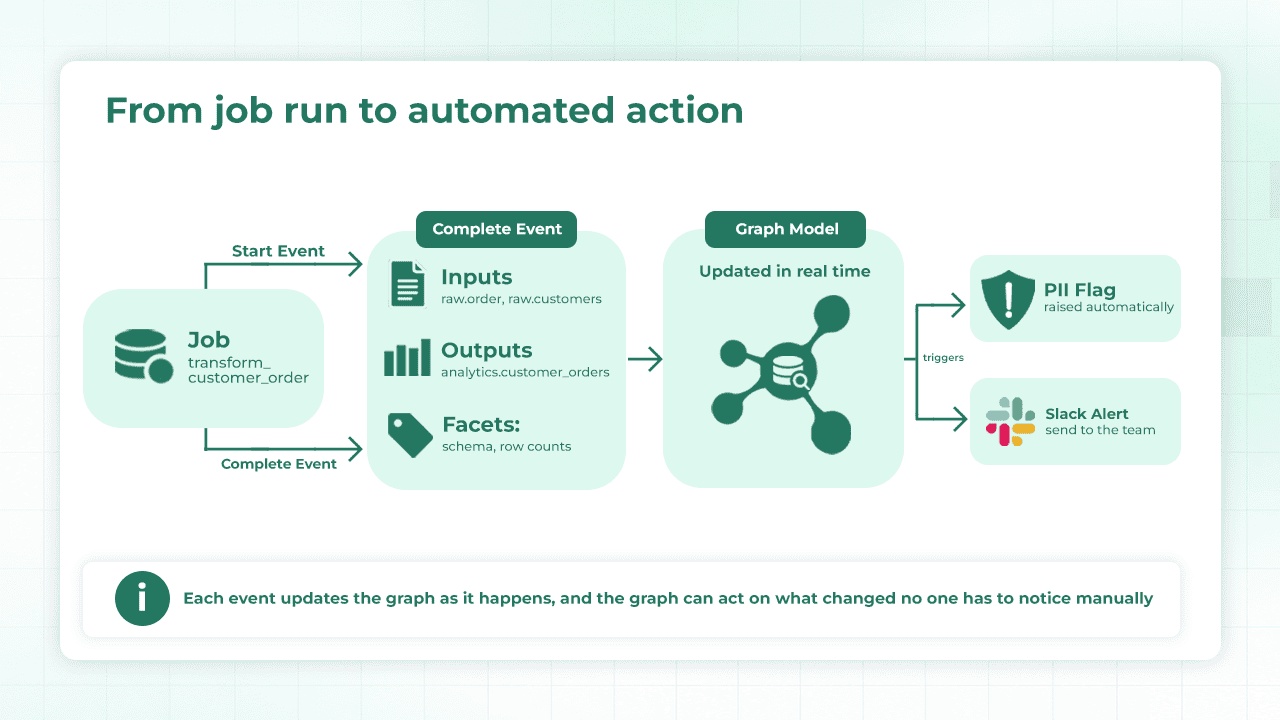
Observed, or dynamic, lineage avoids that gap by capturing dependencies from the run itself, after identifiers resolve and the job executes. This is what event-driven collection provides by default: since the metadata system receives an event describing exactly which datasets a job read and wrote, it doesn’t need to guess from source code what might happen; it records what did happen. Column-level lineage builds on this same foundation, tracing not just “this job reads that table” but which specific output column derives from which specific input columns, which requires the system to know each table’s schema and resolve ambiguous references like a wildcard select or an unqualified column in a multi-table join against that schema, rather than guessing from query text alone.
Graph-based relationship modeling turns that stream of observed events into a connected structure instead of a flat table. Each dataset, job, and run becomes a node; each dependency between them, down to the column level where schema is available, becomes an edge. This structure supports two kinds of queries a flat catalog can’t answer well:
- Forward traversal: starting at a table and walking downstream to find every job, dataset, and dashboard that depends on it.
- Backward traversal: starting at a broken dashboard and walking upstream to find the job or change that caused it.
A catalog built purely on static parsing can answer both questions incorrectly, since it’s reasoning about what a pipeline might do rather than what it actually did.
Automated action is what most static catalogs never had. Once the graph knows a new dataset exists, or a schema just changed, it can trigger a response: flag a table for containing sensitive fields, open a ticket when a risky change ships, or alert the team that owns a downstream dependency. This turns metadata from something people check into something that checks itself.
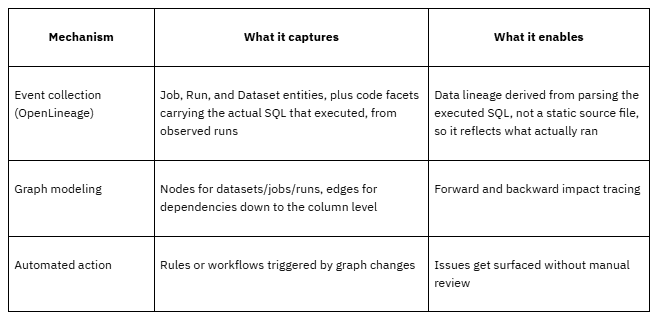
Knowing how the graph gets built is one half of the picture. What that graph actually changes in day-to-day data work is the other.
How Does Active Metadata Change Day-to-Day Data Work?
Active metadata changes three common data engineering tasks, shifting each from reactive detective work to something closer to a built-in check.
Impact analysis happens before a change ships, not after something breaks. An engineer can see, at the point of editing a pipeline, exactly which downstream tables, dashboards, and jobs depend on what they’re about to touch, whether that check happens during development or automatically as part of a pull request.
Root-cause tracing runs the same logic in reverse. When a dashboard breaks or a job fails, a team can trace backward through the graph to the actual change that caused it, instead of manually checking each upstream system one at a time.
Governance and compliance checks move from periodic audits to continuous monitoring. Rather than a quarterly review to catch personally identifiable information sitting in the wrong place, an active system flags it the moment a dataset containing it appears.
These same mechanics extend past human engineers checking their own work. AI coding agents making changes to the same pipelines need the same context, and stale metadata affects them differently than it affects a person.
Why Do AI Coding Agents Need Active Metadata?
AI coding agents increasingly write and modify data pipeline code directly, and that is where stale metadata becomes a safety problem rather than an inconvenience. An agent editing a dbt model or an Airflow DAG needs to know what depends on the thing it’s about to change, and a catalog that was accurate three weeks ago doesn’t help with that.
This problem is also different in kind from general AI coding tasks. Michael Stonebraker’s research on real-world text-to-SQL performance found that pure LLM-generated SQL scored close to zero accuracy against a benchmark built from actual enterprise data warehouse query logs, with retrieval-augmented and agentic approaches raising that to only the 10-20% range, compared to the 90%+ scores the same class of models posts on clean, academic text-to-SQL benchmarks, according to Stonebraker’s own article for the ACM. Production data estates accumulate years of schema drift, inconsistent naming, and business logic nobody documented anywhere a model can read it, which academic benchmarks built on clean public databases don’t capture. Active metadata closes that gap by giving an agent a current, structured picture of the data estate instead of asking it to infer one from stale documentation or none at all.
This is why active metadata management increasingly comes up alongside agentic data engineering rather than as a separate governance topic. Agents need accurate, real-time context to operate safely, and active metadata systems exist specifically to provide it. Getting that right at rollout, though, is where most of the practical difficulty actually sits.
Where Do Active Metadata Rollouts Commonly Go Wrong?
A handful of specific mistakes account for most of the gap between an active metadata rollout that works and one that quietly doesn’t.
- Connecting a source system without instrumenting the orchestration layer that runs it. Registering a warehouse as a source captures its tables, but if the orchestrator running jobs against it (Airflow, dbt Cloud, or similar) isn’t separately emitting run events, the graph knows the tables exist without ever seeing what touches them. The result looks connected but stays effectively static.
- Treating a one-time export as if it were a live feed. A bulk metadata import is a reasonable way to bootstrap a graph with historical context, but it’s a snapshot, not a subscription. If nothing is emitting ongoing events after that import, the graph starts accurate and drifts exactly like a passive catalog would, just from a more complete starting point.
- Turning on automated actions before the graph has enough history. A system that fires alerts or opens tickets based on a graph still filling in its first few days of data tends to flag normal, first-time-seen activity as anomalous, since it has no baseline yet to compare against. This creates enough noise that teams often mute the automation entirely before it has a chance to become useful.
- Assuming schema-aware column-level lineage works without schema access. Column-level tracing depends on the system being able to resolve ambiguous references against actual table schemas. Without that access, wildcard selects and unqualified joins fall back to table-level lineage only, which is easy to mistake for a bug rather than a missing permission.
- Skipping the systems that feel too small to matter. A small, manually-run script that feeds a widely-used dashboard is exactly the kind of dependency active metadata is meant to catch, and it’s also the kind most likely to get deprioritized during rollout because it doesn’t look significant on its own.
These are the failure modes worth ruling out before judging whether active metadata is working. The easiest way to see what a successful rollout looks like is through a working implementation.
How Does Datameer Apply Active Metadata?
Datameer’s approach is a working example of these mechanisms applied together.
Continuous, cross-platform ingestion. It ingests metadata continuously from across a company’s data systems using open standards like OpenLineage, so a job run, schema change, or new dataset appears in the system as it happens rather than at the next scheduled scan.
A graph built from what actually ran, not what code says it should do. That metadata gets modeled as a live graph connecting datasets, jobs, and job runs, built from what jobs actually executed rather than inferred from static code. Datameer extends this beyond standard data lineage, which tracks where data came from and how it was transformed, to also model operational lineage: what actually happened at runtime, not just what depends on what.
Most lineage tools stop at telling an engineer which downstream models will break. Datameer’s graph also carries the runtime metrics behind each job run:
- How long it took
- How many rows it produced
- How many bytes it scanned
Comparing two versions of the same job means comparing what changed operationally, not just what changed structurally. A change that scans more data dramatically or runs dramatically slower shows up before it becomes an incident, not after. Because the graph is built from observed runs, tracing a downstream impact means walking real recorded dependencies, not dependencies a parser guessed at from a query template.
Impact analysis at the point of review. This shows up concretely in how a change actually gets reviewed, not just in the abstract. When an engineer opens a pull request that touches a pipeline, a webhook triggers an automated impact report directly on that PR, so nobody has to remember to run a check or go look something up first.
That report can be discussed right where the work already happens:
- In the PR thread itself
- Through Slack
- In a web chat
- From a CLI
Point-in-time history and live telemetry in the same context. Because the graph keeps a versioned history with point-in-time reads, it can also answer what the estate looked like at a specific moment in the past, useful when an incident being investigated happened days or weeks earlier, not just what things look like right now. And because the graph reaches into operational telemetry like Datadog in the same context as lineage data, an engineer chasing down an alert doesn’t have to leave one tool to go check logs in another.
Back to the running example. Revisit the earlier scenario: the same rename of customer_email in analytics.customer_orders. With this model in place, the outcome looks different. The graph already knows this column feeds twelve downstream datasets and three active dashboards, including the revenue dashboard the analyst built earlier, because it recorded those dependencies from prior runs, not from documentation someone would have needed to update by hand. The change doesn’t ship silently.
The automated-action layer works at two points:
- At development time, the graph feeds context directly to AI coding agents through an MCP and CLI integration. An agent editing a pipeline can be told a column it’s about to rename or redefine is used across a dozen downstream datasets before the change ships.
- At the operational level, event-triggered workflows can flag sensitive data, open GitHub issues, or notify a team automatically when a change in the graph matters enough to act on.
Understanding the mechanics and seeing a working example is most of the way there. What’s left is a practical starting point for a team weighing this shift for their own data estate.
How Should a Data Team Start Adopting Active Metadata?
Three capabilities matter most when evaluating a move toward active metadata, more than treating it as a single feature to buy:
- Event-driven ingestion. A catalog that updates weekly across fifty systems is still passive, regardless of how many connectors it supports.
- Graph-based relationship modeling. Impact analysis and root-cause tracing both depend on modeled relationships, not search and tagging features layered onto flat metadata.
- Automation hooks. The value of active metadata compounds once the system can act on what it knows, rather than displaying it to someone who has to notice and respond.
Connecting the systems most central to daily operations first, typically the primary data warehouse and the orchestration tool running most jobs, delivers value faster than attempting to connect the entire data estate at once.
Conclusion
Static data catalogs fail not because teams don’t care about documentation, but because a growing data estate changes faster than anyone can manually track it. Active metadata management solves this by collecting metadata continuously through event-driven ingestion, modeling it as a connected graph rather than a flat list, and triggering automated action when something changes, whether that’s flagging sensitive data, opening a ticket, or warning an engineer before a schema change ships. The same gap becomes a safety issue once AI agents start writing and modifying pipeline code directly, since an agent working from a three-week-old catalog has no way to know what it’s about to break.
Datameer applies this model directly, building a live graph of datasets, jobs, and job runs from observed execution rather than static code, and using it to power impact analysis and root-cause tracing today, with development-time context for AI coding agents on its roadmap. Teams evaluating this shift don’t need to overhaul their entire data estate at once; connecting the systems that matter most first, then expanding from there, is a reasonable place to begin. Explore how Datameer approaches active metadata to see what this looks like applied to your own data estate.
FAQs
Is active metadata management the same as data observability?
They overlap but aren’t identical. Data observability tools typically focus on detecting anomalies in data quality and alerting when something looks wrong. Active metadata management is broader: it covers how metadata about the entire data estate, including schemas, lineage, and relationships, gets continuously collected and modeled, which observability tools often depend on as an underlying layer.
Do you still need a data catalog if you have active metadata?
Yes, though the distinction matters less in practice. A catalog is the interface people use to search and browse metadata. Active metadata management describes how current and complete that catalog’s underlying information stays. A catalog built on active metadata simply stays accurate automatically instead of drifting out of date.
How long does it typically take to implement active metadata management?
This depends on the number of systems being connected and how standardized the data estate already is. Teams often see initial value within weeks by connecting their most central systems first, rather than attempting a full rollout across every system on day one.
Does active metadata work across hybrid or multi-cloud data estates?
Systems built on open standards like OpenLineage are designed specifically for this case, since the standard doesn’t depend on any single vendor’s infrastructure. Any system that can emit lineage events, whether running on-premises, in one cloud, or across several, can feed into the same metadata graph.
What’s the difference between active metadata and real-time analytics?
Real-time analytics queries and analyzes data itself as it arrives. Active metadata management tracks information describing that data and the systems producing it, such as schemas, lineage, and job runs, as those change. The two can work together, but they answer different questions: one is about what the data says, the other is about what’s happening to the data.