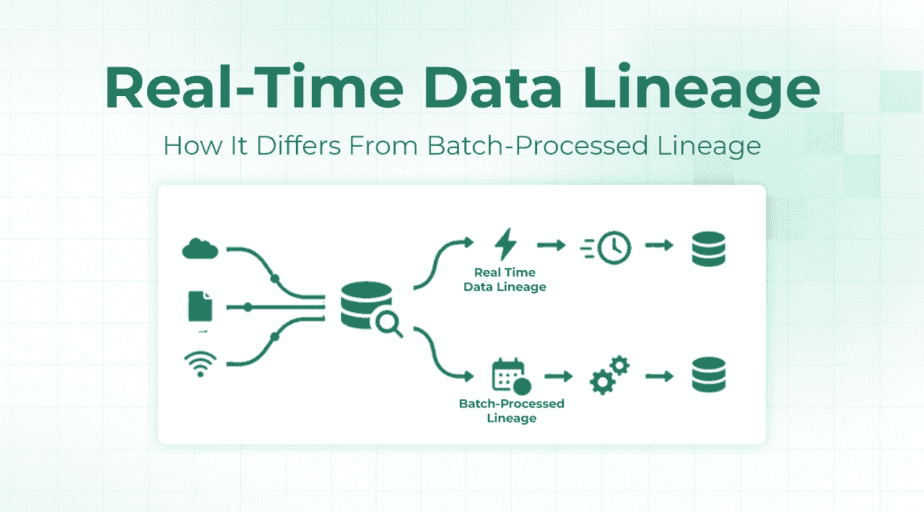
Real-Time Data Lineage: How It Differs From Batch-Processed Lineage
- September 29, 2026
TL;DR
- 66% of IT leaders cite uncertainty around data lineage, timeliness, and quality as a top barrier to scaling AI initiatives, according to Confluent’s 2026 Data Streaming Report, a survey of 4,625 IT leaders worldwide.
- Batch-processed lineage reconstructs pipeline activity after a scheduled scan runs, which works when there’s a stable window to inspect, but an active data estate has jobs running and schemas changing constantly, with no such pause.
- Real-time lineage depends on job runs and schema changes being emitted as metadata events, not periodic scans, so the graph reflects what happened as it happens rather than inferring it afterward.
- The same 2026 Confluent research found 72% of IT leaders cite insufficient infrastructure for real-time data processing as a barrier to scaling AI, up from 61% the year before.
- Datameer builds real-time lineage on this same event-driven foundation, capturing job runs and dataset changes as they occur rather than reconstructing them on a schedule.
Event-driven architectures now sit at the center of how most companies run their data pipelines, not on the edges of it. Confluent’s 2026 research puts data streaming among the top investment priorities for 88% of IT leaders surveyed, and the same report ties a large share of stalled AI initiatives directly to gaps in real-time infrastructure and lineage visibility. Lineage itself, the record of where data came from and how it moved, hasn’t always kept pace with that shift.
This piece breaks down what changes when lineage tracking moves from batch to real-time: why the batch model depends on an assumption streaming pipelines don’t share, what technical components actually make lineage real-time, and how that changes incident response when something breaks mid-stream. It builds on the mechanics covered in this site’s piece on active metadata management, which covers the graph model and automated-action layer lineage feeds into; this piece focuses specifically on the capture layer underneath it, and how that layer differs once data stops arriving in scheduled batches.
What Changes When Data Lineage Runs in Real Time?
Data lineage records where a piece of data came from, what transformed it, and where it ended up. Every data pipeline produces lineage in some form; the question is when that record gets created relative to when the data actually moved.
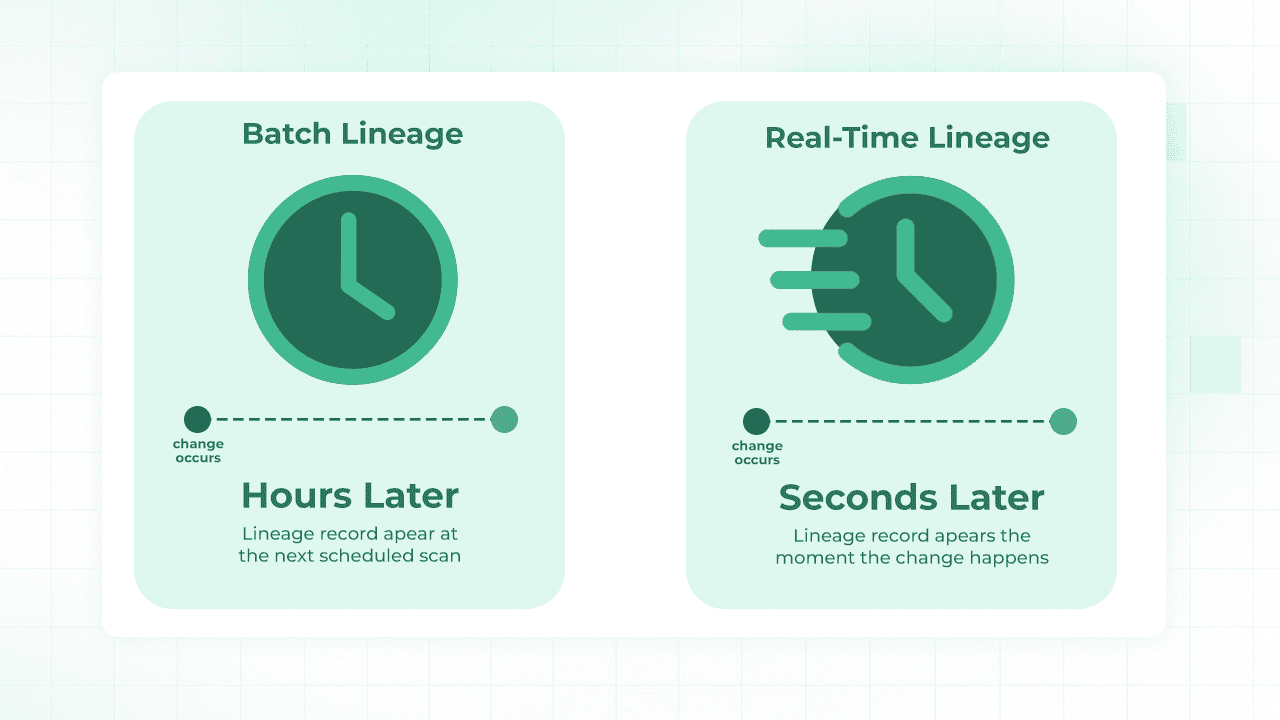
Batch-processed lineage creates that record after the fact. A nightly job runs, logs get written, and a lineage tool parses those logs or scans the resulting tables sometime after the job completes, building a picture of what happened during a window that’s already closed. This works because batch pipelines have a natural pause point: the job starts, runs, and finishes, and lineage tooling has a stable, unchanging result to inspect once it’s done.
Real-time lineage removes that pause point. Consider a concrete example, threaded through the rest of this piece: a column gets renamed in a source table two teams both depend on, and that schema change needs to show up in the lineage graph within seconds, not at the next scheduled scan. It isn’t the underlying data that’s moving in real time here; it’s the metadata describing it: a job ran, a schema changed, a dataset’s shape shifted in a way that could break something downstream. There’s no batch job to wait for; the event is in flight the moment it happens, so lineage must be captured then or it’s already behind.
| Dimensions | Batch-processed lineage | Real-time lineage |
| Capture point | After a scheduled job completes | At the moment a change occurs |
| Capture method | Log parsing or table scans | Job-run and schema-change events |
| Typical lag | Minutes to hours, tied to schedule | Seconds |
| Assumes | A stable, closed window to inspect | Continuous, ongoing data movement |
| Well suited to | Nightly reporting, infrequently updated tables | Fast-moving pipelines feeding operationally critical systems, where incident response can’t wait for the next scan |
Why Does Batch-Processed Lineage Break Down in Streaming Systems?
Static lineage assumes a stopping point that an active estate doesn’t provide. A batch lineage tool can wait, scan the completed output, and reconstruct what happened because nothing else changed in the estate in the meantime. A production data estate never reaches that kind of pause. Jobs keep running, schemas keep shifting, and new pipelines keep shipping, so there’s no closed window left to scan after the fact.
This creates a specific, practical gap. Consider the scenario this piece keeps coming back to: a faulty SQL procedure ships as part of a routine pipeline change, and it quietly starts feeding bad inputs into a downstream fraud-detection system. False positives start piling up, and someone has to answer what changed, who shipped it, and when it started affecting that system, using both the data lineage and the operational lineage from every system involved. If lineage is captured only through periodic scans, the code change and its downstream effects are already fully absorbed by the time the next scheduled scan records that the change happened. For that window, anyone investigating has no record of a change that’s already caused real damage. The system was accurate the whole time about which pipelines existed, but wrong about when anyone could actually see what one of them had just done.
The scale of this mismatch is growing, not shrinking. IT leaders are already flagging it directly: 66% cite uncertainty around data lineage, timeliness, and quality as a barrier to scaling AI initiatives, according to Confluent’s 2026 Data Streaming Report. A lineage system built to reconstruct history after a batch window closes no longer has a batch window to wait for; closing that gap requires capturing changes at the source, not scanning for them afterward.
What Technical Components Make Lineage Real-Time?
The mechanism isn’t complicated: real-time lineage comes from emitting a metadata event the moment something happens in a pipeline, rather than waiting for a scheduled process to go looking for it afterward. What “something happens” means here is a job run, a schema change, a new dataset appearing, not a row-level update to a piece of business data moving through a database.
Tools like Airflow, dbt, and modern orchestrators already emit events like this using open standards such as OpenLineage: a job starts, a job completes, a dataset’s schema shifts shape. A metadata system that listens for these events as they’re emitted has a current picture of the estate. One that waits and periodically scans for the same information always describes a version of the estate that’s already stale.
This is what it looks like for a job to emit that event as it runs, using OpenLineage’s own Python client:
| from datetime import datetime, timezone
import uuid from openlineage.client import OpenLineageClient from openlineage.client.event_v2 import RunEvent, RunState, Job, Run, InputDataset, OutputDataset client = OpenLineageClient(url=“https://lineage.internal.example.com”) event = RunEvent( eventType=RunState.COMPLETE, eventTime=datetime.now(timezone.utc).isoformat(), run=Run(runId=str(uuid.uuid4())), job=Job(namespace=“warehouse.prod”, name=“dbt.transform_fraud_features”), inputs=[ InputDataset(namespace=“warehouse.prod”, name=“raw.transactions”), ], outputs=[ OutputDataset(namespace=“warehouse.prod”, name=“fraud.feature_table”), ], producer=“https://github.com/OpenLineage/OpenLineage/tree/1.22.0/integration/dbt”, ) client.emit(event) # This event alone doesn’t say anything went wrong. What it does is put a # timestamped, attributable record of “this job ran, with this SQL, against # these tables” into the graph the moment it happened. That record is what # lets someone trace a downstream incident back to the exact job run later, # instead of reconstructing it from logs after the fact. |
A run like this arrives at the metadata system within moments of the job actually executing, not the next time a scheduled scan happens to check. That’s the entire mechanism; nothing depends on tracking individual data changes inside a database or on any change-data-capture infrastructure. The metadata system only needs to hear about pipeline-level events, job runs, schema changes, new datasets, as they happen.
This is a different layer from the graph-based relationship modeling covered in the active metadata piece; that piece explains how captured events get turned into a connected graph of datasets, jobs, and dependencies. This section covers what gets those events captured and delivered in the first place. Getting the capture layer right changes what’s possible once something actually breaks.
How Does Real-Time Lineage Change Incident Response?
Real-time lineage turns root-cause tracing into something that happens while an incident is active, not after it’s already resolved itself one way or another, and it does that by combining two things that are usually tracked separately: which datasets and jobs depend on each other (data lineage), and what actually ran, when, and with what code (operational lineage).
Return to the running scenario: a faulty SQL procedure ships as part of a routine pipeline change, and false positives start piling up in a downstream fraud-detection system. In the batch model, answering what changed, who shipped it, and when means waiting for the next scan, then reconstructing a timeline from logs that are already hours old, by which point the fraud-detection system has been acting on bad inputs the whole time, with no way to intervene while it still mattered.
With real-time lineage, the same investigation runs against a graph that’s already current on both fronts. An engineer can trace the false positives backward through the data lineage to the exact feature table the fraud model reads, then forward through the operational lineage to the specific job run, and the specific code change that touched that table right before the false positives started. That combination is what actually answers the question: data lineage alone can say the fraud model depends on that table; only the operational side can say which run, and which change, is the one that broke it. This is the same forward-and-backward graph traversal covered in the active metadata piece; the difference here is how fresh the graph is, on both the data and operational sides, at the moment someone needs to query it.
That freshness is also where real-time lineage rollouts most commonly run into trouble.
Where Do Real-Time Lineage Systems Commonly Break Down?
A handful of specific failure modes account for most of the gap between a real-time lineage system that’s genuinely current and one that only looks that way.
- A source system that isn’t actually wired to emit events. Registering an orchestrator or a job as a source is easy; making sure it’s actually configured to emit a run event every time it executes is a separate step, and it’s easy to miss. If a job runs without emitting, the lineage graph has no record that it ran at all, and nothing about the graph looks obviously broken; it just quietly stops reflecting part of the estate.
- Mistaking micro-batching for true real-time. Some pipelines labeled real-time actually batch events into small windows, seconds or low minutes, before processing them. This is often a reasonable engineering trade-off, but treating it as equivalent to true event-at-a-time capture leads teams to trust freshness the system doesn’t actually provide.
- A lagging metadata consumer going unnoticed. The system that ingests job-run and schema-change events can itself fall behind under load, even when every source is emitting correctly. If that lag isn’t monitored directly, the graph keeps functioning while quietly running minutes or hours stale, the same failure mode as a source that isn’t wired to emit at all, just one layer further downstream.
- Schema drift arriving faster than lineage consumers can handle it. A field added or renamed in a source table shows up in the event stream immediately, not on a deploy schedule. A lineage system that assumes schemas change slowly can misinterpret or drop these events instead of adapting.
Knowing where this breaks is most useful once there’s something concrete to check it against.
How Does Datameer Implement Real-Time Lineage?
Datameer’s approach to lineage capture follows this same event-driven model rather than a scheduled one. Metadata is captured from job-run events and schema-change events as they happen, using open standards like OpenLineage, so a pipeline change appears in the lineage graph within moments of running, not the next time a scan happens to check.
Revisit the running scenario one more time: a faulty SQL procedure ships as part of a routine pipeline change, and it starts feeding bad inputs into a downstream fraud-detection system. Because Datameer’s lineage capture is event-driven rather than scheduled, the job run that shipped that change is already in the graph, data lineage and operational lineage together, by the time anyone notices the false positives. An engineer investigating the alert can trace it back through the data lineage to the exact table the fraud model reads, then through the operational lineage to the specific job run and code change that touched it, while the incident is still live, rather than reconstructing that timeline from logs after the fact.
This capture layer feeds the same graph model described in the active metadata piece, datasets, jobs, and job runs connected as a live structure, with the operational side carrying what actually ran and when, not just what depends on what. The freshness of that graph, on both the data and operational sides, is a direct function of how quickly those events get captured in the first place, which is what this piece has focused on.
How Should a Team Move From Batch to Real-Time Lineage?
Not every pipeline needs real-time lineage, and treating “real-time” as automatically better than batch is its own kind of mistake. A finance table that updates a few times a day rarely justifies the added infrastructure, monitoring, and on-call surface that real-time capture introduces. The pipelines worth prioritizing are the ones where a delay in lineage visibility has a real operational cost: systems feeding fraud detection, anything customer-facing, or any pipeline where an incident needs answering before the next scheduled scan catches up.
Starting by instrumenting the orchestrators and jobs feeding those specific pipelines to emit events, rather than attempting to convert an entire data estate to real-time capture at once, keeps the added complexity scoped to where it actually pays off.
Conclusion
Batch-processed lineage assumes a pause between runs that a live estate doesn’t actually provide, which is why scanning logs after a scheduled job finishes stops working once teams need to know what’s happening now, not what happened at the last scan. Real-time lineage closes that gap by capturing job runs and schema changes as they happen, rather than waiting to look for them, so data and operational lineage stay current at the same time. That shift matters most during incident response: when a pipeline change breaks something downstream, having up-to-date context on both fronts, what depends on what, and what actually ran, when, is what turns a multi-hour investigation into one that happens while the incident is still live.
Datameer builds its lineage capture on this same event-driven foundation, reflecting job runs and schema changes in the graph as they happen rather than reconstructing them afterward, while supporting batch ingest for systems where that’s the better fit. Teams don’t need every pipeline on real-time capture at once; starting with the systems where a stale lineage record actually costs something during an incident is a reasonable place to begin. Explore how Datameer approaches real-time lineage to see what event-driven capture looks like applied to your own estate.
FAQs
Is real-time data lineage the same as streaming analytics?
No. Streaming analytics processes and analyzes data as it arrives, generating insights or triggering actions based on the data’s content. Real-time data lineage tracks where that data came from and how it moved, as a record of movement rather than an analysis of the data.
Does real-time lineage require replacing an existing batch lineage setup entirely?
Not necessarily. Many organizations run both, keeping batch-based lineage for pipelines that don’t need immediate visibility while adding real-time capture specifically for latency-sensitive systems like fraud detection or live operational monitoring.
Is this the same as change data capture (CDC)?
No. CDC tracks row-level changes to data inside a database, typically by reading its transaction log. Real-time lineage here tracks a different layer: metadata events like job runs and schema changes, emitted by orchestrators and pipeline tools using open standards like OpenLineage. It’s about knowing that a job ran or a schema shifted, not about tracking individual data values as they change.
How much infrastructure does real-time lineage actually require?
It depends on what’s already in place. A team already running modern orchestration tools that support open standards like OpenLineage can often turn on event emission with comparatively little new infrastructure. A team running older or custom-built pipelines without that instrumentation faces a larger lift, since emitting those events is a separate step that has to be added first.
Can real-time lineage catch a problem before it reaches production?
It can catch a problem faster than batch lineage can, since the record exists within moments of a change rather than after a scheduled scan. Whether that translates into catching an issue before it reaches production depends on whether automated action is wired to that lineage graph; real-time visibility alone still requires something to act on what it sees.