Data Catalog Software: Six Checks to See If Yours Is Ready for AI Agents
- Infrasity
- November 12, 2026
TL;DR
- Gartner expects over 40% of agentic AI projects to be canceled by the end of 2027, with inadequate risk controls among the main reasons.
- AI agents write far better queries when metadata is handed to them than when they have to dig it out themselves. On the Spider 2.0 benchmark, top scores reach nearly 97% with prepared metadata and 65.6% when the agent has to work through a project's own code.
- Six checks separate an agent-ready catalog from a searchable one: a callable interface, freshness measured against the last deploy, lineage built from observed runs, column-level traversal in both directions, context delivered before a merge, and agent-level permissions with an audit trail.
- A catalog can score well on search, tagging and documentation coverage and still fail every one of those checks, because none of them show up in a UI demo.
- Callisto by Datameer builds its graph of datasets, jobs and runs from observed events, derives column-level lineage by parsing each job's SQL, compares runtime metrics such as bytes scanned between two versions of a job on a GitHub pull request, and has MCP and CLI access for coding agents in private beta.
Most data catalogs on the market were designed around a person with a question. Someone opens a search box, types part of a table name, reads a description, and decides whether the data is what they need.
A coding agent works differently. It needs the same facts in a form it can request, at the moment it writes a change, and it has no way to tell a stale answer from a current one.
This piece covers what agent readiness means for a data catalog, the six checks to run against the catalog your team already has, and how to test each one without vendor help.
What data catalog software does and how the category changed
A data catalog inventories an organization's data and records what each piece means. A typical platform holds four kinds of information:
- Technical metadata. Tables, columns, types, partitions, and where each object physically sits.
- Business context. Definitions, metric logic, glossary terms, and the owner to ask when a number looks wrong.
- Lineage. Which jobs produced a dataset and which reports read it.
- Operational signals. Freshness, quality test results, query volume, and who used an asset last.
The category was built around discovery. An analyst searches for a table, reads the description, checks the owner and the last refresh, and decides whether to trust it. Search ranking, tagging and glossary workflows all follow from that one job.
Three things have moved since. Collection shifted from scheduled scans to event-driven ingestion, so the record updates when a job runs rather than when a crawler next sweeps. Lineage moved from the table to the column, which is the level at which a change breaks a report. And the consumer changed, because an AI agent now reads the catalog and ships changes to the pipelines it describes.
The first two shifts were about accuracy. The third changes who the product serves, and that is what an evaluation has to account for now.
What agent readiness means for a data catalog
A catalog is agent-ready when it can answer three questions programmatically and currently: what a dataset means, what it depends on, and what depends on it. The requirement is that the answer comes back through a call rather than a page, and reflects the estate as it stands today.
There is a write side to this as well. Agents do not only read catalogs, they ship changes to the pipelines the catalog describes, which makes the catalog part of the review path rather than a reference shelf next to it.
Why catalogs built for human search leave agents guessing
The gap shows up clearly in benchmark results. When an AI agent gets clean metadata and documentation alongside each question, as in the Spider 2.0-Snow setting, leading submissions now clear 96%. When it has to work out dependencies by reading a project's code, as in the benchmark's task built on dbt (the SQL transformation tool many data teams use to build their models), the best score is 65.6%.
The same class of models runs both settings, so the gap comes from how much context arrived in a form the agent could use.
A catalog built for human search withholds that context in three specific ways:
- It answers in pages, not payloads. An agent mid-edit cannot open a search UI, and an export it was handed last week describes a different estate.
- It describes intent rather than behavior. Documentation written by hand records what a pipeline was meant to do, which diverges from what it does within a few refactors.
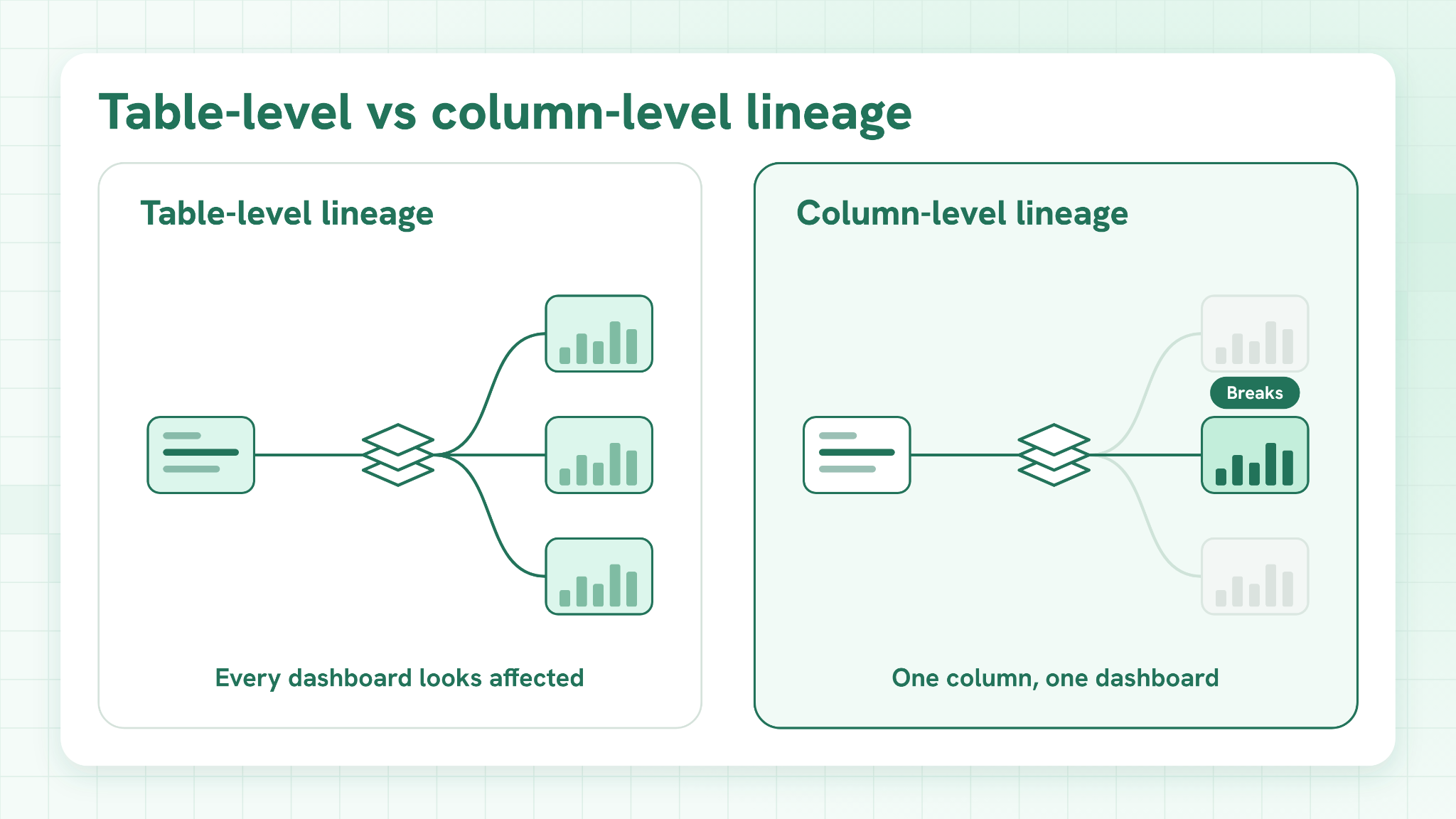
- It stops at the table. Agents change columns, and a dependency map that stops at table granularity cannot tell an agent that one field feeds a finance dashboard.
Six checks to test whether your catalog is agent-ready
Each check below has a test a team can run against a platform it already owns, in an afternoon, without vendor help.
A machine interface the agent can call directly
Ask whether the catalog exposes metadata through an interface an agent can call, such as an MCP server or a typed API, rather than a search page plus a scheduled export. MCP, the Model Context Protocol, is an open standard that lets AI agents call outside tools and data sources in a consistent way. The interface decides whether catalog context reaches the agent during the work or after it.
How to test it: ask the vendor to show the exact call an agent makes to retrieve a table's schema, owner and downstream dependents, and ask what the response contains when the agent starts with nothing but a column name.
Freshness measured against the last deploy rather than the last scan
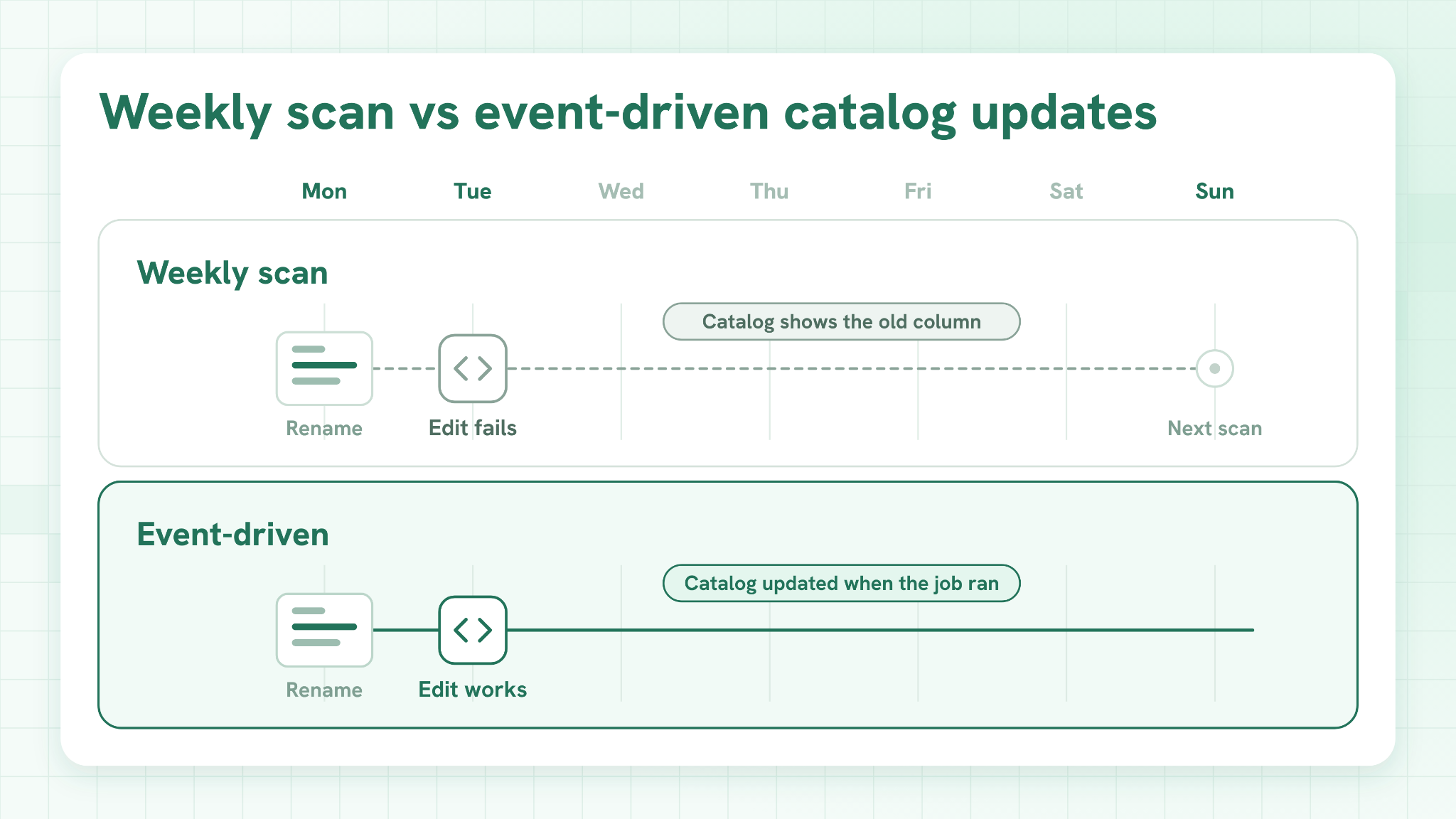
The number to settle is how long a schema change takes to appear in the catalog. Suppose we have a company where an engineer renames a column during a Monday refactor and an agent edits a model that reads it on Tuesday. A catalog on a weekly scan cycle will hand that agent a column that no longer exists.
Event-driven collection is what closes that window, and it is the main thing separating active metadata management from a catalog that happens to have many connectors.
How to test it: rename a column in a non-production schema, then query the catalog on the hour and record when the change shows up.
Lineage that includes observed runs alongside parsed code
Static parsers read SQL and model files and infer dependencies without executing anything. They work on a clean join and lose the thread on dynamic SQL assembled at runtime, stored procedures with conditional branches, and table names resolved from parameters.
Lineage captured from execution records what a job read and wrote, which is the version an agent needs before it touches production code. Real-time data lineage is built on exactly this distinction.
How to test it: point the catalog at a pipeline that builds a table name from a parameter, run it, and check whether the resulting dependency appears without anyone documenting it.
Column-level dependencies that traverse in both directions
Forward traversal answers what breaks if a column changes. Backward traversal answers what changed when a dashboard goes wrong. Agents need both, and table-level lineage gives neither with enough precision to act on.
Ask as well how the platform handles edges it cannot resolve with certainty. A system that marks a name-matched edge as inferred gives an agent something to weigh, while one that asserts every edge equally breeds false confidence.
How to test it: pick a column feeding a business-critical report, ask the catalog for every downstream object that reads it, and compare the list against what a senior engineer on that team knows.
Context delivered before the change merges
A catalog an agent has to remember to consult is a catalog that gets skipped under time pressure. The stronger pattern pushes impact into the review surface, so a pull request that renames customer_email in analytics.customer_orders carries the list of affected datasets and dashboards on the pull request itself.
How to test it: open a pull request that renames a column and see whether anything appears without a person running a check first.
Agent identity, scoped permissions and an audit trail
Risk controls are one of the reasons Gartner gives for agentic projects being canceled, and catalog access is where a lot of that risk sits. An agent should hold its own credential rather than borrowing an engineer's, with read scope you can narrow and a log of what it read and changed.
How to test it: issue a credential for a test agent, restrict it to a single schema, confirm the refusal when it reaches outside that schema, and find the corresponding entry in the log.
Where agent-readiness checks on a catalog go wrong
A few patterns separate a check that predicts production behavior from one that does not:
- Judging the catalog on sample data instead of your estate. Demo environments run on clean data with complete documentation, which is the condition agents already handle well.
- Assuming the platform's native catalog covers the estate. A warehouse's built-in catalog describes what sits inside that warehouse. Agents change pipelines that cross an orchestrator, a BI layer and whatever legacy system nobody wants to touch.
- Testing the read path and skipping the write path. Retrieval is the easier half. Whether an agent gets told what its change affects before the merge is the half that prevents incidents.
- Leaving small scripts out of scope. A manually run script feeding a widely used dashboard is the dependency most likely to be missed and most likely to cause the outage.
How Callisto by Datameer handles agent-facing catalog context
Callisto by Datameer ingests metadata continuously from Snowflake, other non-dbt sources and any system that emits OpenLineage events. OpenLineage is an open standard pipelines use to report what each job read and wrote, so a job run, schema change or new dataset lands in Datameer as it happens. It runs alongside the catalog a team already has rather than replacing it, and it is separate from Datameer Cloud, the no-code Snowflake transformation product.
The graph connects datasets, jobs and job runs recorded from observed events, with column-level lineage derived automatically by parsing each job's SQL, so the runs show what executed and the parsed SQL shows which columns fed which. Edges matched on name alone are flagged as inferred rather than asserted, and systems outside current coverage are surfaced as unmapped instead of quietly dropped.
What the graph carries beyond structure is runtime behavior. An impact report compares two versions of the same job on job duration, result rows, result bytes, bytes scanned and records read, so a change that quadruples bytes scanned surfaces at review time. Most lineage tools can tell an engineer which models break, and this one also says what the new version costs to run.
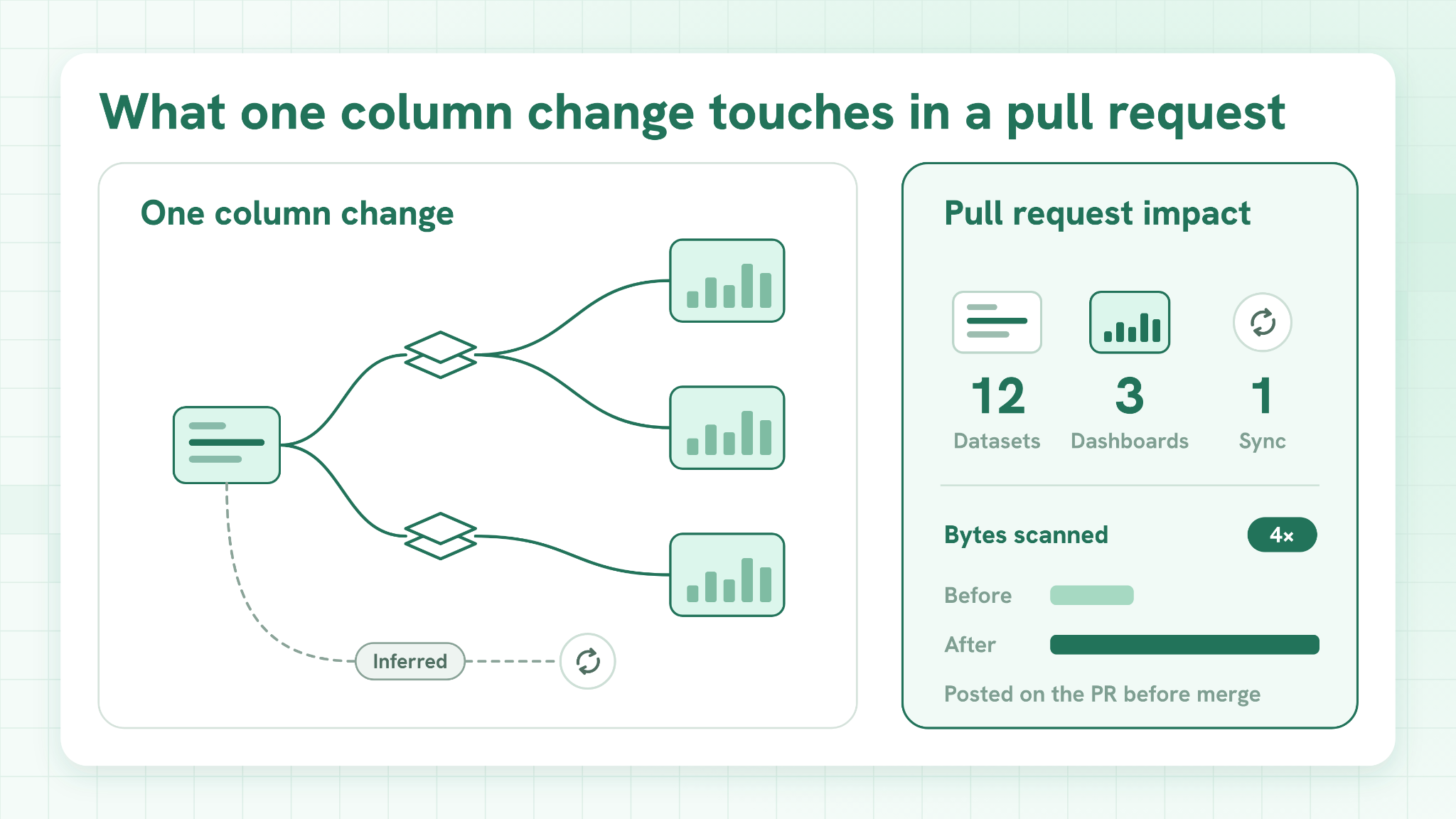
That report reaches a GitHub pull request through a webhook, and the system can be questioned from the PR thread, Slack, a web chat or the CLI. Versioned metadata with point-in-time reads answers what the estate looked like during an incident weeks earlier.
Development-time context for coding agents, delivered over MCP and the CLI, is in private beta with design partners. An agent can be told that a column it is about to rename feeds a dozen downstream datasets before the change ships.
Conclusion
Agent readiness in a data catalog comes down to whether context reaches the agent in a form it can request, at the moment it needs it, describing the estate as it stands. Search quality and documentation coverage say little about any of that, which is why a catalog can look strong in a demo and leave agents working from a picture that is weeks out of date.
Run the six checks against whatever you have now before adding another platform to the stack. Book a demo to see how Callisto by Datameer builds this context across your data estate.
FAQs
Does an agent-ready catalog replace the data catalog we already have?
Not usually. The catalog stays the place people search and browse, and agent readiness is about how it collects metadata and serves it to agents. In most cases the question is whether the current platform can be extended rather than swapped.
Is MCP support enough to call a catalog agent-ready?
No. MCP makes metadata callable, but the answer is only as current as what sits behind it. An MCP server in front of a catalog refreshed weekly still hands agents week-old answers.
How much metadata coverage do agents need before this is worth doing?
Coverage of the systems agents touch counts for more than coverage of the whole estate. Most teams see value sooner by instrumenting the primary warehouse and the orchestrator that runs most jobs, then expanding from there.
Which systems does Callisto collect metadata from?
Callisto reads from OpenLineage-emitting systems, Snowflake and other non-dbt sources, and builds column-level lineage by parsing each job's SQL. Systems it does not yet cover are flagged as unmapped, so a team can see where coverage stops.
How does Callisto show the impact of a change before it merges?
When a pull request on GitHub touches a pipeline, a webhook triggers an impact report on that PR. The report lists the downstream datasets and dashboards the change reaches and compares runtime metrics such as bytes scanned and job duration between the old and new versions of the job.
Can AI coding agents query Callisto directly?
Yes, through MCP and the CLI, which are currently in private beta with design partners. An agent can ask what depends on a column before it changes it, and get the same lineage and runtime context an engineer sees on the pull request.